
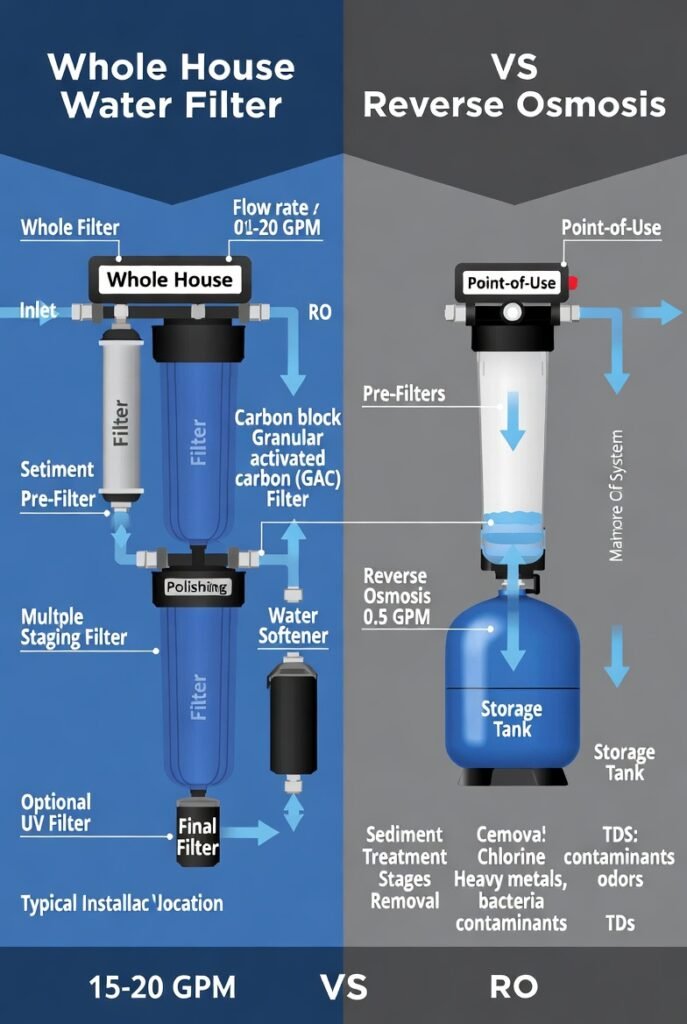
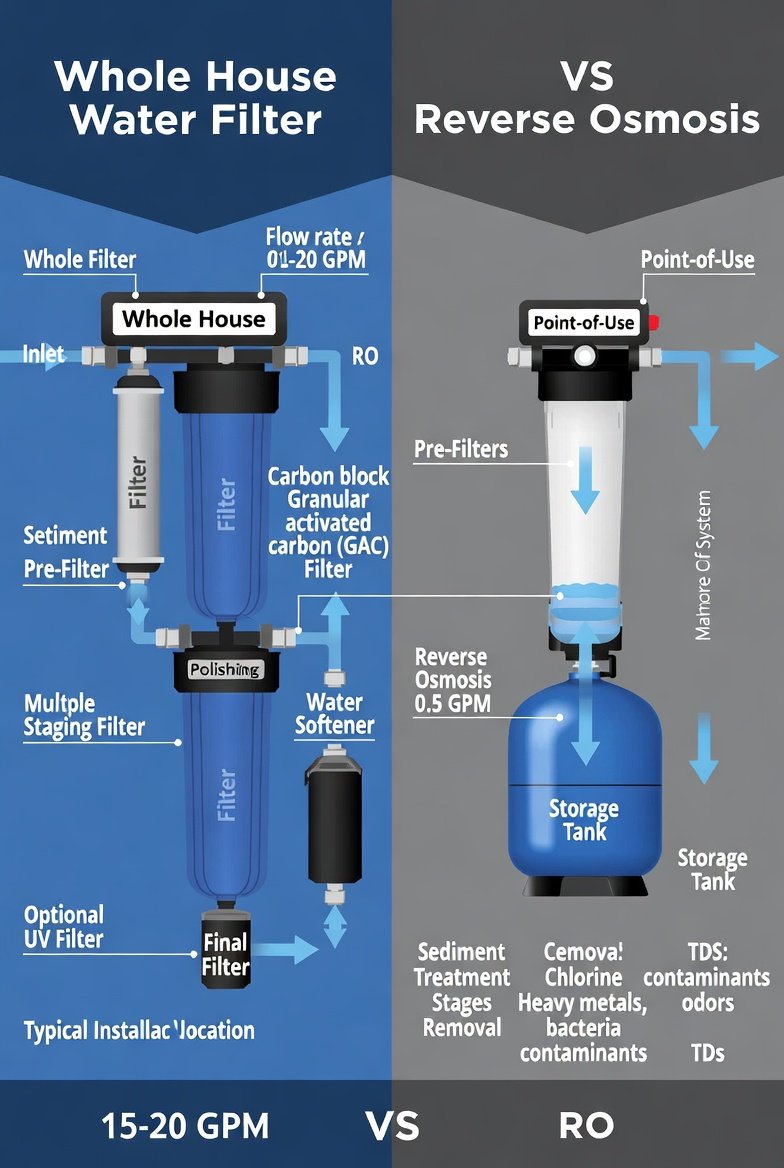
Whole House Water Filter vs Reverse Osmosis
Most homeowners don’t choose the wrong system because they’re careless.
They choose wrong because they misunderstand the boundary.
A whole house water filter treats water at the main line.
A reverse osmosis (RO) system purifies drinking water at a single tap.
When those roles get mixed up, people:
- Install RO expecting plumbing protection
- Install whole-house carbon expecting bottled-water purity
- Overspend
- Under-protect
This guide fixes that confusion clearly.
Start Here: The Decision Boundary
If your concern affects:
- 🚿 Showers, pipes, appliances → Whole house filter
- 🥤 Drinking purity, fluoride, high TDS → Reverse osmosis
- 🏠 Infrastructure + drinking water → Layered system
That’s the structural truth.
Structural Difference: POE vs POU
Whole House Filter = Point of Entry (POE)
Installed where water enters your home.
Treats everything downstream:
- Shower valves
- Faucet cartridges
- Dishwasher solenoids
- Tankless heat exchangers
- Water heater elements
If chlorine and sediment pass the entry point, every component downstream absorbs that load.
For a full layout breakdown, see:
👉water-filter-for-entire-house
This is infrastructure defense.
Reverse Osmosis = Point of Use (POU)
Installed under a sink.
Feeds:
- Dedicated faucet
- Sometimes refrigerator line
RO treats a small volume with very high precision.
It does not treat your plumbing system.
That distinction matters more than brand comparisons.
Flow Capacity: The Hidden Dealbreaker
This is where most comparison articles fail.
Whole House Systems
Rated in Gallons Per Minute (GPM).
Typical sizing:
- 7–10 GPM (small home)
- 10–15 GPM (3–4 bath home)
- 15–20+ GPM (large home)
Real-world example:
Two showers (5 GPM each)
Washer (2–3 GPM)
Kitchen faucet (1–2 GPM)
Total peak: 12–15 GPM.
Whole house systems are built for this.
Reverse Osmosis Systems
Rated in Gallons Per Day (GPD).
Typical residential membrane:
50–100 GPD production
That equals roughly:
0.03–0.07 GPM filtration rate.
RO relies on:
- Slow membrane separation
- Storage tank buffering
Trying to use RO for full-home demand results in:
- Severe pressure collapse
- Excessive reject water
- Accelerated membrane wear
RO is not structurally designed for whole-home use.
Contaminant Removal Comparison
Issue | Whole House Filter | Reverse Osmosis |
Sediment | ✔ | ✔ |
Chlorine | ✔ | ✔ |
Chloramine | ✔ (catalytic carbon) | ✔ |
VOCs | ✔ | ✔ |
Hardness | ✘ | ✘ |
TDS | ✘ | ✔ |
Fluoride | ✘ | ✔ |
Nitrates | ✘ | ✔ |
Whole-house systems improve water quality at scale.
RO reduces dissolved contaminants at drinking level.
Common Homeowner Mistake #1
“If RO removes more, why not just install it for everything?”
Because purification speed and distribution demand are different engineering problems.
RO is precision filtration.
Whole-house systems are flow management systems.
Confusing those creates plumbing stress.
Hardness Clarified (Scale Protection Reality)
Hardness is dissolved calcium and magnesium.
Neither whole-house carbon nor RO replaces a softener for scale control.
RO may reduce dissolved solids slightly — but it is not engineered to protect plumbing from mineral buildup.
If scale is the problem, see:
👉water-softener-system-cost
Taste vs Safety Boundary
Whole-house carbon primarily addresses:
- Chlorine
- Odor
- Sediment
- General aesthetic improvements
RO targets:
- Dissolved solids
- Fluoride
- Nitrates
- Certain health-related contaminants
For private wells, the EPA recommends regular testing to determine appropriate treatment before system selection.
Test before you treat.
Wastewater & Environmental Reality
Reverse osmosis produces reject water during membrane separation.
Reject ratios vary depending on:
- Pressure
- Temperature
- Membrane design
- System efficiency
At faucet scale, this is manageable.
At whole-home scale, wastewater multiplies dramatically.
Whole-house carbon systems do not produce reject water.
This is one reason whole-house RO remains rare in residential design.
Common Homeowner Mistake #2
Installing only RO because “drinking water matters most,” while leaving:
- Chlorine attacking the heater
- Sediment clogging valves
- Fixtures degrading
Drinking water quality matters.
But plumbing longevity also matters.
Layered System (The Balanced Strategy)
Many modern homes use:
Main line → Sediment → Carbon → (Softener if needed) → Distribution
Kitchen branch → RO
This setup:
- Protects infrastructure
- Improves shower water
- Provides purified drinking water
For pricing breakdowns:
👉whole-house-water-filtration-system-cost
Maintenance Comparison
Whole House
- Sediment: 3–6 months
- Carbon: 6–12 months
- Media tanks: multi-year lifespan
Reverse Osmosis
- Pre-filters: 6–12 months
- Membrane: 2–5 years
- Post-filter: yearly
RO requires more frequent service cycles.
Whole-house systems require correct sizing and flow management.
Professional Selection Checklist
- Confirm disinfectant type (chlorine vs chloramine)
- Look for NSF/ANSI 42 or 53 certification claims
- Size whole-house system by peak GPM
- Never oversize RO expecting whole-home performance
- Test well water annually
Matching system to chemistry prevents overspending.
Common Homeowner Mistake #3
Assuming one system solves every water issue.
Water treatment is layered by design.
Infrastructure problems require infrastructure solutions.
Drinking purity requires precision solutions.
Trying to force one system to do both often leads to disappointment.
FAQs
Can reverse osmosis replace a whole house filter?
No. RO systems cannot support whole-home flow demand.
Does RO remove chlorine?
Yes, but whole-house carbon is more practical for full-home chlorine treatment.
Does whole house filtration remove fluoride?
Most standard systems do not. RO is typically required.
Can I install RO at every faucet?
Technically possible, but inefficient and costly. RO is best used at select drinking locations.
What happens if RO pressure drops in high-use homes?
Production slows dramatically. Storage tanks may not refill fast enough to meet demand.
Does combining both systems reduce maintenance?
Layering systems distributes treatment load properly but does not eliminate routine maintenance.
Is whole-house RO ever justified?
Only in rare cases involving specific contamination profiles and large, engineered systems.
What protects tankless water heaters?
Whole-house sediment filtration and softening protect heat exchanger components.