
Water Filter for Entire House (The Structural + Performance Guide)
A water filter for an entire house is a point-of-entry (main-line) filtration system that treats water before it feeds your:
- showers
- faucets
- toilets
- washer/dishwasher
- refrigerator line
- water heater / tankless heater
The one boundary that saves you money:
A whole-house filter removes sediment + chemicals (depending on media). It usually does not remove hardness minerals.
If scale buildup is your problem (spots, crusty showerheads, heater scale), start here:
If you’re deciding between system categories (filter vs conditioner vs softener), use:
best-water-conditioning-system
Quick Facts (Snippet Bait)
- Install location: main line, before branch lines + before water heater
- Core jobs: sediment capture + chlorine/chloramine reduction
- Sizing: by peak GPM, not brand
- Micron staging: coarse → fine to avoid pressure drop
- Well water: often needs extra stages (iron/UV)
- Trust marker: look for NSF/ANSI certifications on components/claims
Where It Installs (Trace the Water Like a Plumber)
Correct installation order (most homes):
Main line → Main shutoff → (Prefilter) → Carbon/media stage → (Optional UV) → Cold distribution → Water heater → Hot distribution
Non-negotiables
- Before branch lines (or you only treat part of the house)
- Before the water heater (so hot water is treated too)
- Bypass valve + shutoffs (for service without shutting down the home)
Inspector reality: lack of bypass/shutoffs and sloppy routing is what turns “nice upgrade” into “DIY problem” during a home inspection.
Four Whole-House Filter Layout Archetypes
1) Municipal “Taste/Odor” Layout
Sediment → Carbon
Best when the complaint is chlorine smell, dryness, taste.
2) Municipal “Chloramine” Layout
Sediment → Catalytic carbon
Built for areas where chloramine is used (regular carbon may underperform).
3) High-Flow “Tank + Prefilter” Layout
Spin-down / sediment → Carbon media tank
Better flow stability, longer service intervals.
4) Well Water Treatment Train
Sediment → Iron/sulfur stage → Carbon → UV (common)
Well water has more variability; testing drives the train (more below).
If you need pricing, keep that separate so this page stays structural:
whole-house-water-filtration-system-cost
What It Removes (Typical Whole-Home Goals)
Most whole-house systems (properly specified) target:
- Sediment (sand, silt, rust flakes)
- Chlorine (taste/odor)
- Some VOCs (media-dependent)
- Odor compounds
- Sometimes chloramine (with catalytic carbon)
Authority signal you can use without hype
Many filtration claims are validated through NSF/ANSI standards (commonly 42 for aesthetic effects like chlorine/taste/odor; 53 for certain health-related reductions; 401 for emerging compounds).
What It Does NOT Remove (Common Misbeliefs)
A whole-house filter typically does not remove:
- Hardness minerals (calcium/magnesium) → needs softener
- Dissolved salts / TDS → needs RO (at point-of-use)
- Most fluoride (without specialty media)
- Nitrate (without specialized treatment)
For RO boundary and drinking-water purity:
water-softener-vs-reverse-osmosis
Micron Staging (The Pressure-Drop Trap Most People Create)
Micron rating = particle size capture. The mistake is going “ultra fine” too early.
Practical micron ladder
Stage | Typical Micron | What it’s for | Common mistake |
Prefilter | 20 micron | coarse sand/rust | skipping it on dirty lines |
Main sediment | 5 micron | fine silt/rust | going too fine too soon |
Polish (optional) | 1 micron | very fine particles | using as stage 1 → clogs fast |
A very fine first stage can cause slow showers and frequent changes. This is one of the most common “my whole-house filter killed my pressure” complaints.
Sizing by Flow (GPM) — The Only Sizing Method That Holds Up
Bathroom count sizing
Bathrooms | Typical target flow |
1–2 | 7–10 GPM |
3–4 | 10–15 GPM |
5+ | 15–20+ GPM |
Fast “Peak GPM” estimator
Add the fixtures you might run at once:
- shower (x2) + washer + dishwasher
If that’s common in your house, you’re usually living in the 12–15 GPM reality.
Undersize = pressure dip + filter bypass temptation (people stop using it).
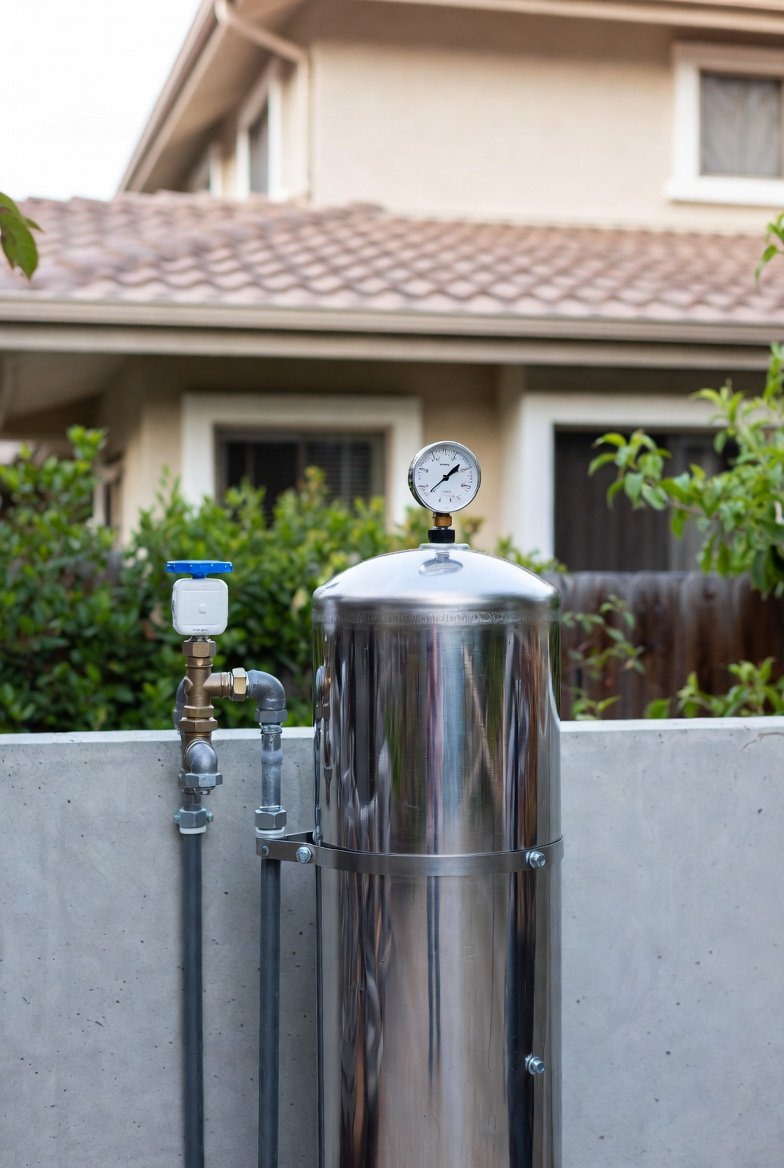
Pressure Drop Reality (Why Layout + Pipe Size Matters)
Pressure drop gets worse when:
- micron is too fine
- cartridges are loaded
- the system is undersized for peak flow
- plumbing is tight (often ¾” lines feeding high-demand homes)
Installer tip: for larger homes, a high-flow design (tank + prefilter) usually behaves better under multi-fixture demand.
Well Water vs City Water (The “Test → Build” Rule)
City water
Most homeowners want chlorine reduction + sediment protection.
Well water
Well water is chemistry-dependent. A “generic” filter train can be wrong.
Minimum recommended testing cadence is commonly annual for key indicators (e.g., coliform bacteria and nitrates, plus other basics).
That testing is what tells you whether you need iron media, carbon type, and whether UV belongs in the train.
Decision Matrix (Choose the System by Symptom)
Symptom / Problem | Primary fix | Notes |
Chlorine smell/taste | Carbon | look for NSF/ANSI 42 claims |
Visible sediment | Sediment staging | coarse → fine |
Orange staining | Iron stage | common well issue |
Rotten egg odor | Sulfur strategy | often needs dedicated stage |
Scale/white spots | Softener | filtration alone won’t solve it |
“I want pure drinking water” | RO at tap | whole-house ≠ RO |
Installer Red Flags (These Cause Failures, Complaints, or Fast Wear)
- no bypass valve
- installed after branch lines
- 1-micron as the first stage
- no shutoffs on both sides
- UV installed without prefiltration
- undersized flow rating for the home
If your layout deviates from the structural logic above, fixing it early prevents pressure loss, wasted cartridges, and “why didn’t this work?” frustration.
ROI Without Cannibalizing the Cost Page
This page is about performance, not price. But the value logic is simple:
- less sediment in heater/tankless
- fewer clogged aerators/valves
- reduced “appliance acting up” problems
- better day-to-day usability (showers/laundry)
For installed costs and ownership math, keep the pricing intent siloed here:
whole-house-water-filtration-system-cost
FAQs
1) Does a whole-house filter remove hardness?
No. Hardness needs a softener.
2) What micron rating should I use?
Most homes do well with 20 → 5 micron staging, and 1 micron only as a final polish if needed.
3) Where should a whole-house filter be installed?
After the main shutoff, before branch lines, and before the water heater.
4) Will a whole-house filter reduce water pressure?
It can if undersized, too fine, or overdue for maintenance. Proper staging + sizing minimizes issues.
5) Does it remove chloramine?
Only certain carbon media (often catalytic) is designed for chloramine performance.
6) Do I need a sediment prefilter before carbon?
Yes if you have visible sediment or old plumbing—sediment loads shorten carbon life.
7) Can I combine a whole-house filter with a softener?
Yes—many homes do both (filter first, then softener is common, depending on design).
8) Should I treat hot water too?
Yes—install before the heater so hot water is also treated.
9) How often should well water be tested?
A common baseline is at least annually for key indicators like bacteria and nitrates.
10) What certifications should I look for?
NSF/ANSI standards are widely used to validate reduction claims (commonly 42/53/401 depending on the claim).
11) Do whole-house filters remove fluoride?
Most do not unless using specialty media designed for it.
12) How long does installation take?
Usually a few hours for a straightforward main-line install; longer if plumbing needs rerouting.