
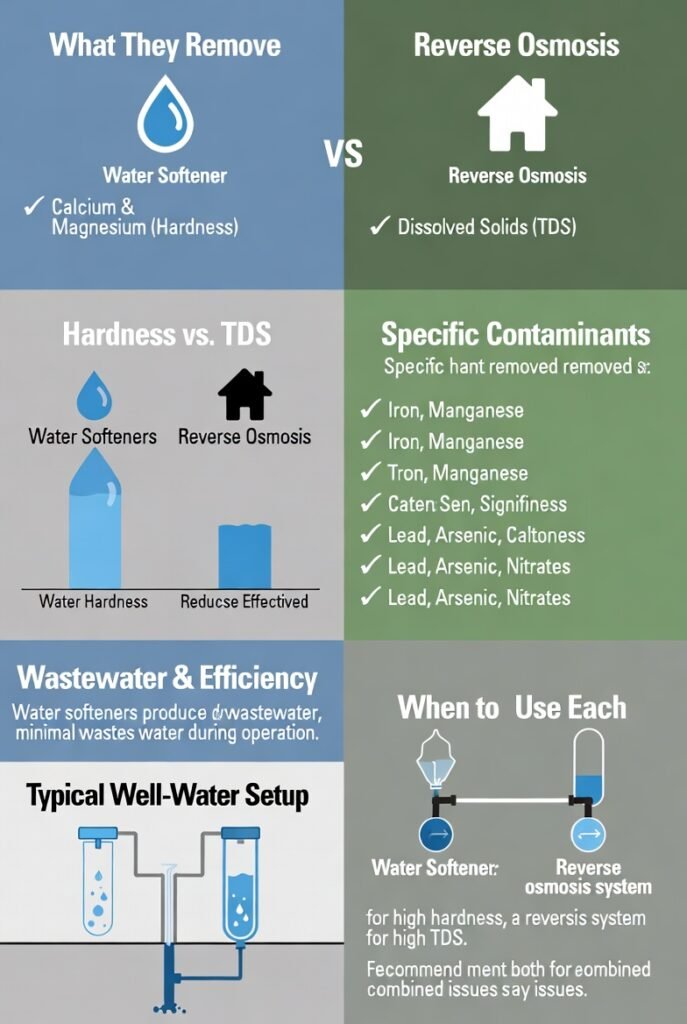
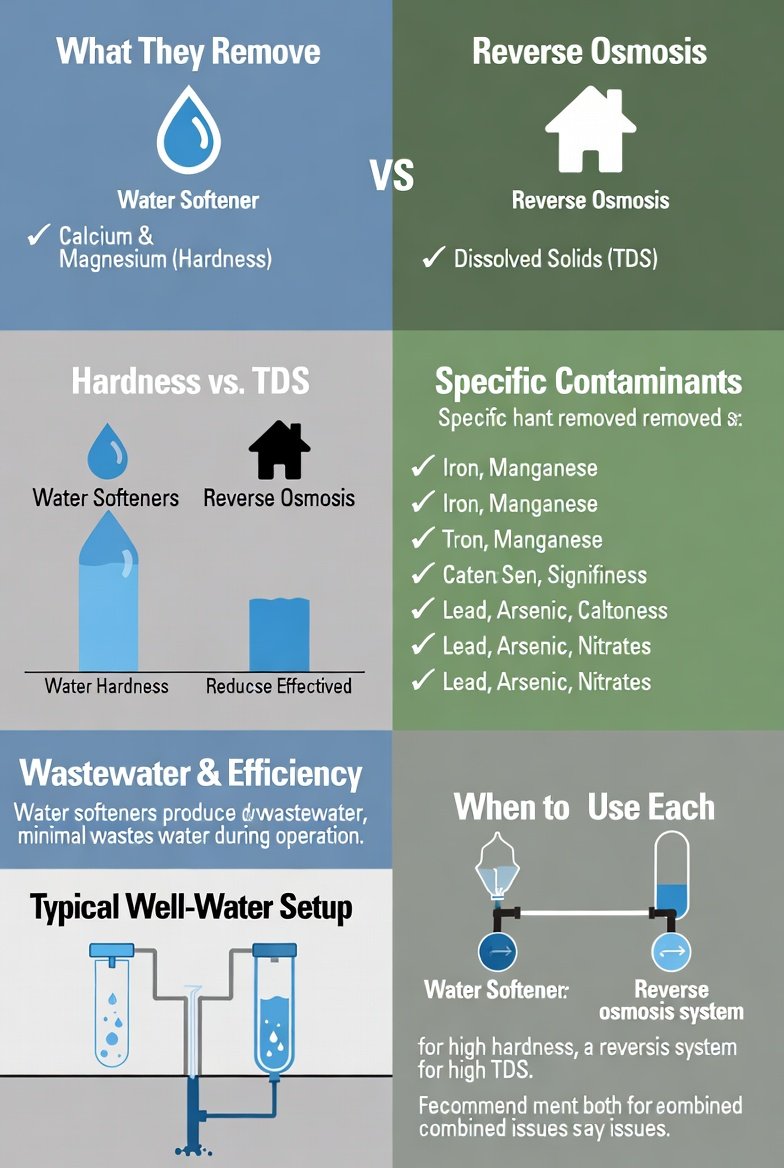
Water Softener vs Reverse Osmosis (They Solve Different Problems)
A water softener and a reverse osmosis (RO) system are not competitors.
They treat different chemistry problems.
If you’re asking which one is “better,” the real question is:
What problem are you trying to solve — hardness or dissolved contaminants?
Understanding that difference prevents wasted money and wrong installations.
For full softener system sizing and capacity guidance, see:
👉best-water-softener-system
What a Water Softener Removes
A traditional softener uses ion exchange resin.
It removes:
- Calcium
- Magnesium
These are hardness minerals responsible for:
- Scale buildup
- Soap scum
- White spotting
- Heater inefficiency
When hardness is removed:
- Grains per gallon (GPG) drop
- Soap lathers better
- Skin feels slick
- Appliances last longer
Cost and ownership expectations are detailed here:
👉water-softener-system-cost
Softening = measurable hardness reduction.
What Reverse Osmosis Removes
Reverse osmosis pushes water through a semi-permeable membrane.
It reduces:
- Dissolved salts
- Nitrates
- Fluoride
- Lead
- Arsenic
- Many dissolved contaminants
RO improves:
- Drinking water purity
- Taste
- Cooking water quality
It does not protect whole-house plumbing from hardness.
Hardness vs TDS (The Critical Difference)
Hardness is a subset of dissolved solids.
- Hardness = calcium + magnesium
- TDS = total dissolved solids (includes salts, metals, minerals)
A softener reduces hardness.
An RO system reduces TDS.
They are not interchangeable.
Example:
- You can have high hardness but moderate TDS.
- You can have low hardness but high TDS.
Testing determines which system you need.
What Each System Removes (Comparison Matrix)
Water Issue | Softener Helps? | RO Helps? | Notes |
Hardness (Ca/Mg) | ✅ Yes | ⚠ Limited | RO reduces some TDS but doesn’t protect plumbing |
Scale buildup | ✅ Yes | ❌ No | RO is point-of-use only |
Lead | ❌ No | ✅ Yes | RO commonly used for reduction |
Fluoride | ❌ No | ✅ Yes | Many RO systems reduce fluoride |
Nitrates | ❌ No | ✅ Yes | RO effective |
Chlorine taste | ❌ No | ⚠ Carbon stage | Carbon filter handles chlorine |
Iron (well water) | ❌ Not reliably | ❌ Not reliably | Requires iron filter |
Bacteria | ❌ No | ⚠ With additional stages | Often needs UV |
This matrix clarifies 80% of confusion.
Flow Rate Reality (GPM vs GPD)
Water softeners operate in gallons per minute (GPM).
Typical whole-house softener:
- 10–15 GPM
RO systems operate in gallons per day (GPD).
Typical under-sink RO:
- 50–100 GPD
RO systems are not designed for showers, laundry, or full-house supply.
They are point-of-use systems.
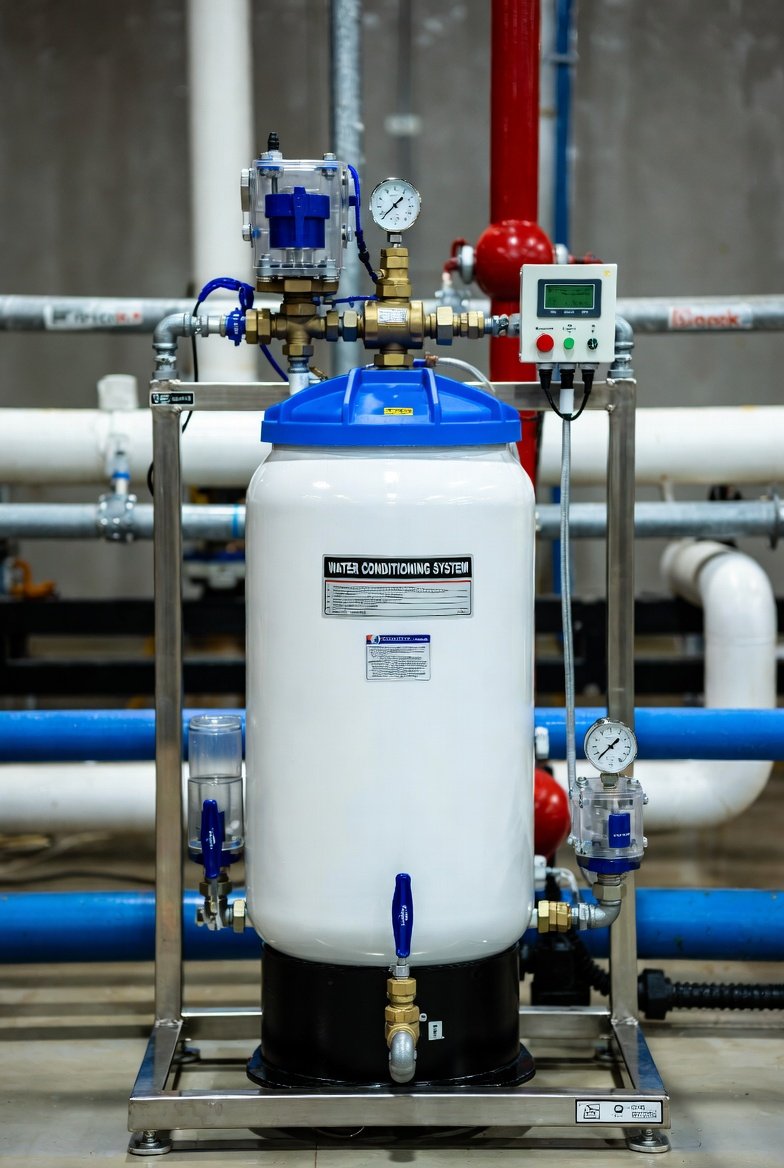
RO Waste-Water & Pressure Reality
Modern RO systems produce wastewater during filtration.
Efficiency varies by model and pressure conditions.
Low water pressure can:
- Reduce production rate
- Increase waste ratio
Some homes require a booster pump to maintain performance.
This is normal system behavior — not a defect.
Whole-House vs Point-of-Use
Water softeners:
- Installed at main water entry
- Protect entire plumbing system
Reverse osmosis:
- Installed under a sink
- Serves one drinking faucet
Whole-house RO systems exist but are:
- Expensive
- Slow-flow
- Rare for standard homes
Most residential setups use both systems separately.
Do You Need Both? (Decision Tree)
Ask:
- Is hardness above ~8–10 GPG?
- Do you see scale buildup?
- Is TDS high?
- Do you want purified drinking water?
If hardness only → Softener.
If drinking purity only → RO.
If both issues exist → Install both.
Softener protects plumbing.
RO protects drinking water quality.
Installation Order (Critical for Performance)
Correct system flow:
Main Line → Softener → House
Kitchen Line → RO → Drinking Faucet
Softened water feeding RO:
- Reduces membrane scaling
- Extends membrane life
- Improves long-term efficiency
Installing RO before softening in hard water zones shortens membrane lifespan.
Well Water Setup Reality
Well systems often require multiple stages.
Typical treatment train:
Well Pump → Pressure Tank → Sediment Filter → Iron Filter → Softener → Carbon → RO or UV
Important:
- Softener does not remove iron effectively at high levels.
- RO is not a whole-house iron solution.
Testing well water is essential before system selection.
Point of No Return (Damage Progression)
Hardness damage escalates.
Early stage:
- Light spotting
- Minor scale
Mid stage:
- Heater efficiency drops
- Fixtures clog
Advanced stage:
- Tankless heat exchanger scaling
- Reduced flow
- Appliance repair costs
Once scale forms inside heaters, correction becomes more expensive.
Softening early prevents escalation.
When You Only Need a Softener
- Hardness above 8–10 GPG
- Spotting and scaling present
- Appliance protection priority
- No contaminant concerns
Salt-free systems may work in mild hardness areas:
👉salt-free-water-softener
When You Only Need RO
- Drinking water taste concerns
- High TDS
- Nitrate or fluoride issues
- Cooking water quality priority
When You Need Both
- Moderate to high hardness
- Elevated TDS
- Appliance protection + purified drinking water
- Well water with mixed chemistry issues
Most homes in moderate-to-hard water regions benefit from pairing both systems.
Common Misconceptions
“RO softens water.”
No. RO reduces dissolved solids but does not protect whole-house plumbing.
“Softener makes water safe to drink.”
It removes hardness but not contaminants like lead or nitrates.
“One system replaces the other.”
They address different chemistry problems.
Final Clarity
Water softener vs reverse osmosis is not about which is better.
It’s about:
- Hardness removal
- Contaminant reduction
Different tools. Different functions.
Understanding the difference prevents wrong purchases.
FAQs
Can reverse osmosis replace a water softener?
No. RO does not protect whole-house plumbing from scale.
Does a water softener reduce TDS?
Only slightly. It primarily removes calcium and magnesium.
Should RO be installed before or after a softener?
After. Softened water protects the RO membrane.
Does RO waste water?
RO systems produce wastewater during filtration. Efficiency varies by system and water pressure.
Is whole-house RO better than softening?
They solve different issues. Whole-house RO is typically unnecessary for most homes.