
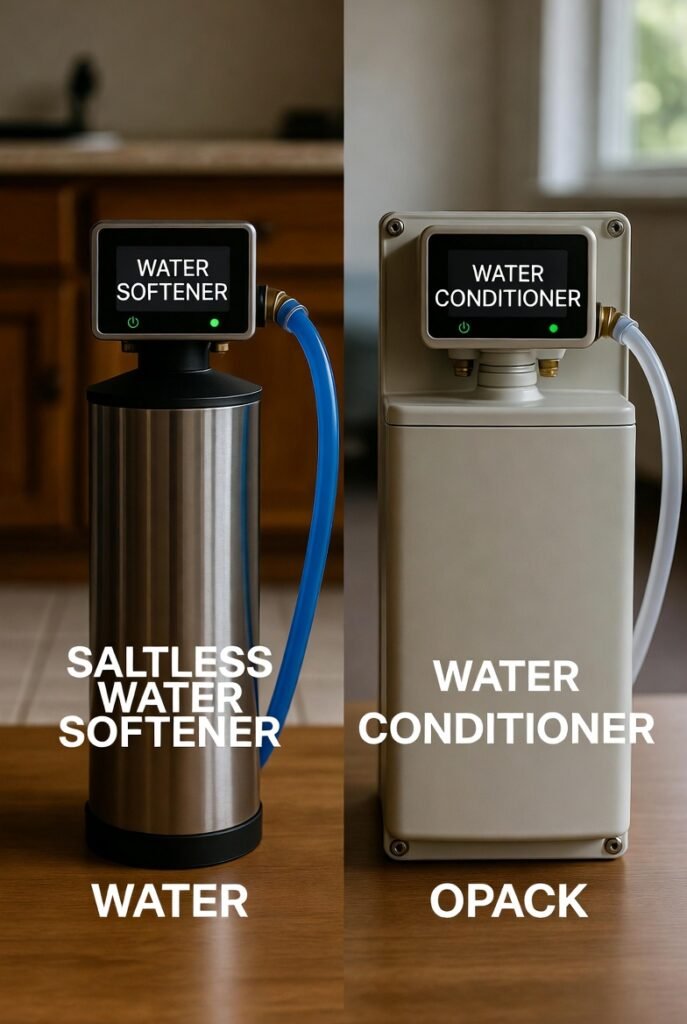
Salt-Free Water Softener System (What It Is — and What It Is Not)
A salt-free water softener does not remove hardness minerals.
It changes how those minerals behave.
That single distinction determines whether it works perfectly in your home — or disappoints you completely.
Most confusion happens because marketing calls it a “softener.” In reality, it is a water conditioner, typically using Template Assisted Crystallization (TAC) technology.
If you’re choosing between systems, this guide explains:
- How salt-free systems actually work
- What they do — and don’t — do to hard water
- Hardness limits where performance drops
- Iron and well water warnings
- Appliance scaling expectations
- When a traditional system is the better choice
If you’re comparing all system types, start with the full overview here:
👉 best system
What Is a Salt-Free Water Softener?
A salt-free system is a scale-prevention conditioner, not an ion-exchange softener.
It does not remove calcium and magnesium from water.
Instead, most systems use Template Assisted Crystallization (TAC) media. When hard water passes through the media:
- Dissolved minerals contact the surface.
- The media acts as a nucleation template.
- Minerals form microscopic crystals.
- Those crystals stay suspended in water.
Because they crystallize, they are less likely to stick to pipes or heating elements.
But the minerals remain present.
Hardness test strips will still show the same GPG level.
What It Does NOT Do (Critical Boundary Section)
A salt-free system does NOT:
- Remove hardness minerals
- Lower grains per gallon (GPG)
- Reduce total dissolved solids (TDS)
- Produce the slippery “soft water” feel
- Significantly reduce soap usage
If you need true hardness removal, an ion-exchange softener is required.
Ownership and performance differences are explained here:
👉water-softener-system-cost
Understanding this boundary prevents expensive misalignment.
Salt-Free Performance by Hardness Level
Performance depends heavily on hardness concentration.
Hardness Level | Expected Performance | Recommended? |
0–7 GPG | Strong scale reduction | ✅ Yes |
7–12 GPG | Moderate performance | ⚠ Possibly |
12–20 GPG | Inconsistent scale control | ❌ Not ideal |
20+ GPG | Likely ineffective | ❌ No |
Hardness Categories:
- 0–7 GPG → Mild
- 7–12 GPG → Moderate
- 12+ GPG → High
- 20+ GPG → Very high
In high hardness regions (15+ GPG), scale can still form inside heaters and fixtures even with TAC systems.
What Happens in Very Hard Water (Real-World Outcome)
In 18–25 GPG areas:
- White spotting may continue on glassware
- Tankless heater heat exchangers may still accumulate scale
- Soap lather does not noticeably improve
- Mineral residue may remain on shower doors
This is where many homeowners feel “it didn’t work.”
The system may reduce scale adhesion, but it does not eliminate mineral presence.
Appliance Impact (Tankless & Dishwashers)
Salt-free systems may help reduce hard crust buildup inside:
- Storage tank heaters
- Dishwashers
- Ice makers
However:
In extreme hardness conditions, tankless heater heat exchangers can still accumulate mineral deposits because crystallized particles are still present.
If heater protection is your primary goal, traditional softening provides stronger scale control.
Iron & Well Water Warning
Salt-free systems are sensitive to iron.
If iron exceeds ~0.3 ppm:
- Media can foul
- Crystallization efficiency drops
- Performance declines rapidly
Homes with:
- Iron staining
- Rotten egg odor (sulfur)
- High sediment
Should pre-filter iron before considering TAC systems.
Well systems often require:Well Pump → Pressure Tank → Sediment Filter → Iron Filter → Conditioner
Salt-Free vs Magnetic vs Polyphosphate Systems
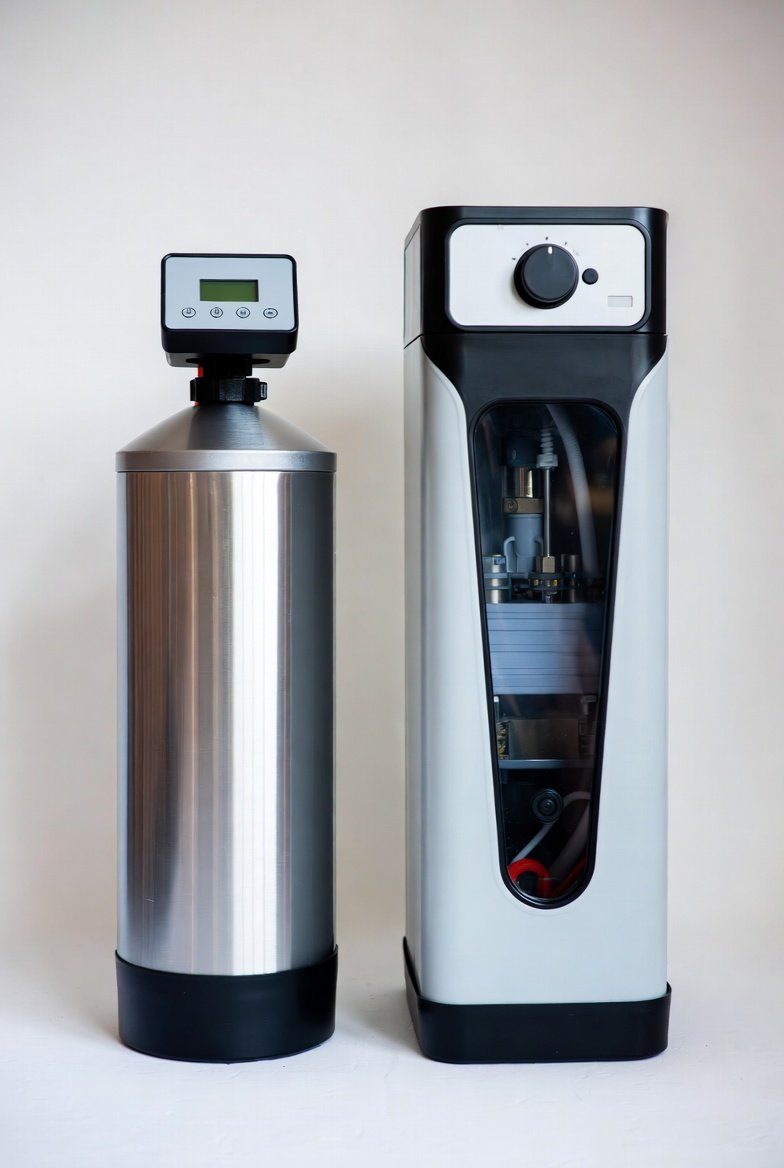
Not all “salt-free” systems are equal.
Technology | How It Works | Effectiveness |
TAC (Template Media) | Crystallizes minerals | Moderate scale reduction |
Polyphosphate | Binds minerals chemically | Limited, short-term |
Magnetic/Electronic | Alters mineral behavior via fields | Inconsistent, debated |
TAC systems are generally more reliable than magnetic units.
But none remove hardness like ion exchange.
Pressure & Flow Advantages
Salt-free systems:
- Do not regenerate
- Produce no wastewater
- Use no salt
- Have minimal pressure fluctuation
Typical residential flow ratings:
- 10–15 GPM for whole-house units
Because there is no backwash cycle, flow remains stable.
This is beneficial in water-restricted areas.
Maintenance & Lifespan
Typical media lifespan:
- 6–10 years (varies by water quality)
No salt refilling required.
No regeneration cycles.
No brine tank cleaning.
However, once media degrades, replacement is required.
There is no chemical recharge cycle like salt systems.
Quick Decision Guide (5 Questions)
Ask yourself:
- Is my hardness below 12 GPG?
- Do I have low iron levels?
- Do I care more about scale than soft feel?
- Do I live in a salt-discharge restricted area?
- Do I want minimal maintenance?
If yes to most → salt-free may work.
If no → consider traditional softening.
Compare system types here:
👉water-softener-vs-reverse-osmosis
Who Salt-Free Systems Are Best For
- Mild to moderate hardness homes
- Municipal water users
- Low-iron water profiles
- Areas restricting salt discharge
- Owners prioritizing low maintenance
Who Should Avoid Salt-Free
- Hardness above 15–20 GPG
- Iron-heavy well water
- Homes seeking soap efficiency
- Households wanting soft-water feel
- Severe scale zones
Traditional ion exchange is stronger in these cases.
System Boundaries (Preventing Overselling)
Salt-free systems do NOT remove:
- Chlorine
- Fluoride
- Heavy metals
- Bacteria
- High TDS
If contaminant removal is required, compare additional treatment systems here:
👉water-softener-vs-reverse-osmosis
Match the system to the problem — not marketing claims.
Final Reality Check
Salt-free water softener systems are not scams.
They are simply miscategorized.
They are:
Scale-reduction conditioners — not hardness removal devices.
When matched properly to water chemistry, they reduce mineral adhesion and lower maintenance.
When mismatched to high hardness or iron-heavy water, they underperform.
Correct expectations determine satisfaction.
FAQs
Does a salt-free water softener remove hardness minerals?
No. It conditions minerals but does not remove them.
Will hardness test strips change after installation?
No. Hardness readings remain largely the same.
Does salt-free reduce soap usage?
Not significantly. Soap lather improvement is minimal compared to traditional softeners.
Is TAC safe for drinking water?
Yes. TAC systems do not add chemicals to water.
How long does TAC media last?
Typically 6–10 years depending on water quality and usage.
Can salt-free work on well water?
Only if iron and sediment levels are very low or properly pre-filtered.