
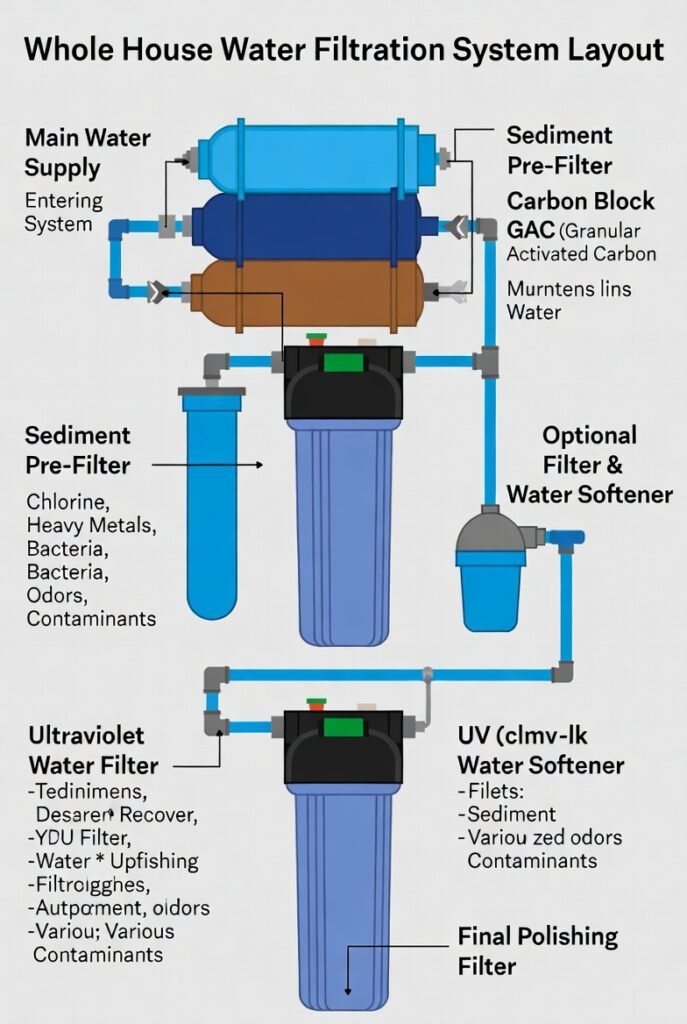
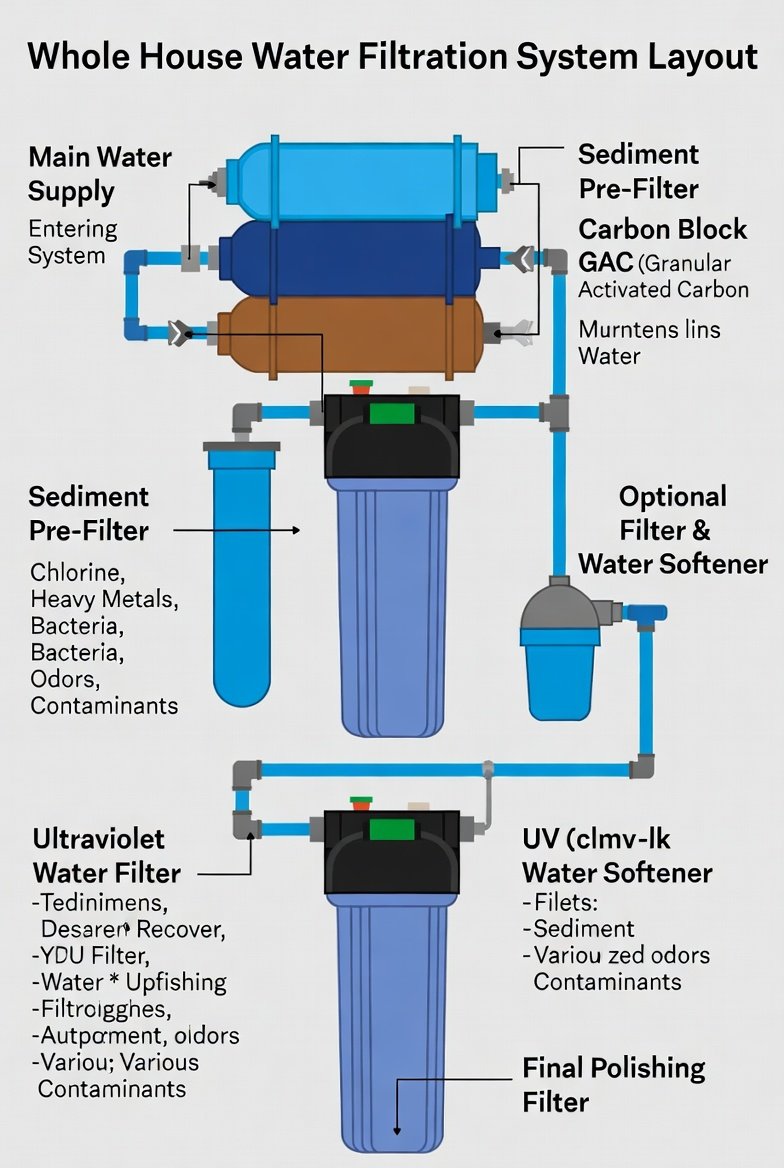
Whole House Water Filtration System Cost (What You’ll Actually Pay)
A whole house water filtration system typically costs:
$1,000–$4,000 installed for municipal water homes
$2,500–$6,000+ installed for well water systems
Those ranges depend on:
- System architecture (cartridge vs tank-based media)
- Flow rate (GPM capacity)
- Number of bathrooms
- Iron or sulfur presence
- Whether UV sterilization is required
- Plumbing access and labor complexity
Before budgeting, make sure you understand what filtration actually covers. A whole-house filter is not the same as a softener or conditioner. If you need that boundary clarified, read:
👉water-conditioning-system
And if your water is hard, filtration alone won’t solve scale problems — see:
👉water-softener-system-cost
Understanding the difference prevents overspending or under-buying.
Installed Cost by System Type
System Type | Equipment Cost | Installed Cost | Typical Flow | Best For |
Basic Sediment + Carbon (Cartridge) | $600–$1,500 | $1,000–$2,500 | 7–10 GPM | Municipal chlorine |
Tank-Based Carbon Media | $1,000–$2,500 | $1,500–$3,500 | 10–15 GPM | Stronger chlorine & organics |
Carbon + UV | $1,500–$3,000 | $2,000–$4,500 | 10–15 GPM | Bacteria risk |
Well System (Iron + Carbon + Sediment) | $1,800–$4,000 | $2,500–$6,000+ | 10–15 GPM | Iron, sulfur, sediment |
Carbon + Softener Combo | $1,500–$3,500 | $2,500–$5,500 | 10–15 GPM | Hard municipal water |
These are realistic U.S. ranges for professional installation in homes with accessible plumbing.
Cost by Home Size (Bathrooms & Flow Rate)
Flow capacity drives price more than brand name.
Home Size | Recommended Flow | Typical Installed Cost |
1–2 bathrooms | 7–10 GPM | $1,000–$2,500 |
3–4 bathrooms | 10–15 GPM | $1,800–$3,500 |
5+ bathrooms | 15–20+ GPM | $2,500–$4,500+ |
Higher GPM systems require larger media tanks and control valves, increasing both equipment and labor cost.
If your system is undersized, pressure drops during simultaneous showers become noticeable.
Cartridge vs Tank-Based Systems (Major Pricing Difference)
Cartridge Systems
- Lower upfront cost
- Replace filters every 3–12 months
- More ongoing maintenance
Best for: smaller homes with moderate water demand.
Tank-Based Media Systems
- Higher upfront cost
- Media lasts 5–10 years
- Fewer frequent changes
Best for: larger homes or long-term ownership planning.
Over 5 years, tank-based systems often cost less in maintenance than frequent cartridge replacements.
Municipal vs Well Water Pricing
Municipal systems usually require:
- Sediment pre-filter
- Carbon filtration
Well water systems often require:
- Iron removal
- Air injection systems
- Larger media tanks
- UV sterilization
That’s why well systems typically start at $2,500+ installed.
If your well water has hardness plus iron, you may need a combined setup similar to what’s explained here:
👉best-water-conditioning-system
Installation Cost Drivers
Professional labor typically ranges from $500–$1,500.
Costs increase when:
- Main line is difficult to access
- Slab foundation requires wall routing
- Electrical outlet needed for UV
- Plumbing reroute is required
- Permit or inspection is mandated
Hidden Add-Ons That Raise Total Cost
- Pressure regulator: +$150–$500
- Spin-down sediment prefilter: +$150–$400
- Bypass valve upgrade: +$100–$250
- Plumbing relocation: +$200–$800
- Electrical outlet install (for UV): +$150–$400
Installer reality matters more than advertised equipment cost.
Maintenance Cost Table (Annual & Long-Term)
Component | Replacement Interval | Typical Cost |
Sediment cartridge | 3–6 months | $20–$60 |
Carbon cartridge | 6–12 months | $60–$200 |
Tank carbon re-bed | 5–10 years | $400–$1,200 |
UV bulb | 12 months | $80–$180 |
Iron media service | 5–10 years | $500–$1,500 |
Well systems generally require more maintenance.
5-Year Ownership Example
Example 1 — 3-Bath Municipal Home
- Installed cost: $2,200
- Filter replacements: ~$300/year × 5 = $1,500
- Total 5-year cost ≈ $3,700
Example 2 — Well Water with Iron
- Installed cost: $4,500
- Maintenance: ~$500/year × 5 = $2,500
- Total 5-year cost ≈ $7,000
This is why upfront price alone doesn’t tell the full story.
When Costs Jump Unexpectedly
Budget increases when:
- Iron exceeds safe limits
- Sediment load is heavy
- Flow demand exceeds 15 GPM
- Tankless heater requires protection
- Plumbing must be reconfigured
Skipping a water test is the fastest way to under-budget.
Filtration vs Softening vs Conditioning (Cost Boundary)
Whole house filtration does NOT remove hardness minerals.
If scale buildup is your primary issue, you likely need a softener instead or in addition to filtration:
If you’re comparing structural treatment types, see:
👉water-softener-vs-reverse-osmosis
And for broader system scope, review:
👉water-conditioning-system
Choosing the wrong system type often doubles long-term cost.
DIY vs Professional Installation
DIY may reduce labor expense but requires:
- Correct bypass configuration
- Leak-free plumbing
- Pressure testing
- Correct placement before heater
Incorrect installation can void warranties or reduce performance.
Is It Worth It? (ROI Perspective)
Whole house filtration can:
- Extend appliance life
- Protect plumbing fixtures
- Reduce bottled water spending
- Improve bathing and odor experience
Example:
If bottled water costs $20/week → $1,040/year
A $2,000 system may recover its cost within 2–3 years depending on usage.
Final Cost Summary
Municipal homes:
Expect $1,000–$4,000 installed.
Well water homes:
Expect $2,500–$6,000+ installed.
5-year ownership:
Typically $3,500–$7,000+ total depending on maintenance and system complexity.
Budget based on water chemistry and flow demand — not marketing claims.
FAQs
How much is labor alone?
Typically $500–$1,500 depending on plumbing complexity.
Does whole house filtration remove hardness?
No. Hardness requires a softener.
Is well water filtration more expensive?
Yes. Iron removal and UV treatment increase system size and cost.
How often do filters need replacement?
Sediment every 3–6 months; carbon every 6–12 months; UV bulbs annually.
How long does installation take?
Most installations take 3–6 hours.
What size system do I need for 15 GPM?
Choose a unit rated at or above peak flow demand to prevent pressure drop.
Does installation require a permit?
In some municipalities, yes.
How long do media tanks last?
Typically 10–15 years with proper maintenance