
Best Water Conditioning System (The Right Choice Depends on Your Water)
There is no single “best” water conditioning system for every home.
The best system depends on:
- Your hardness level (GPG)
- Iron presence
- Flow rate demand
- Whether you want true soft water or just scale control
- Whether drinking water purity is also a goal
Most buying mistakes happen because homeowners skip testing and buy based on marketing.
If you’re unclear on the difference between saltless systems and softeners, read this first:
👉saltless-water-softener-vs-conditioner
This guide gives you a clear decision framework.
First: What Problem Are You Solving?
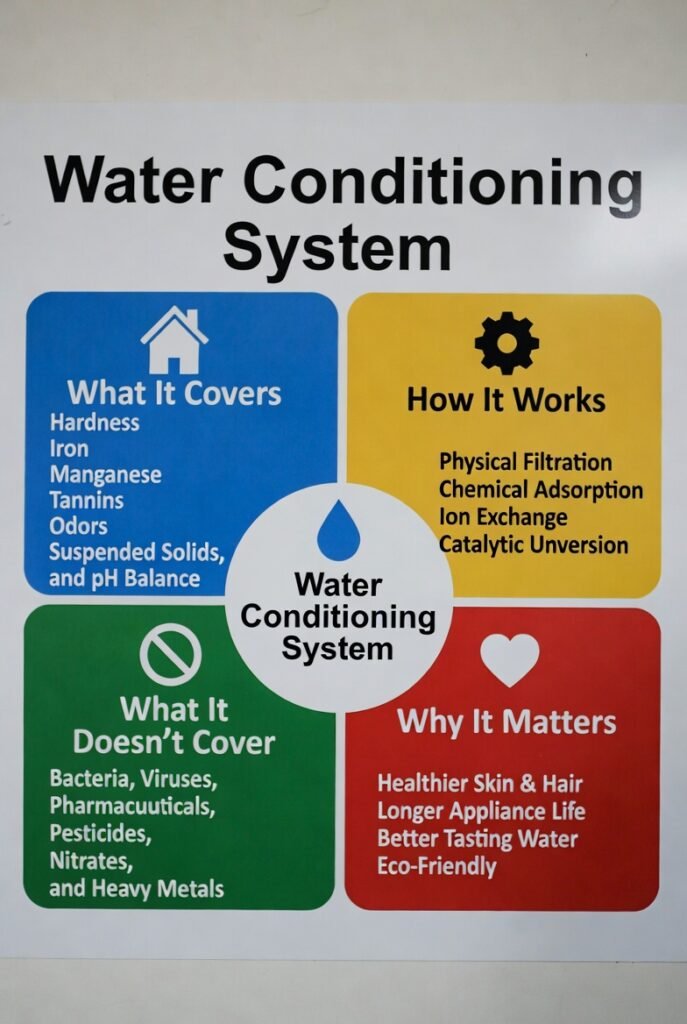
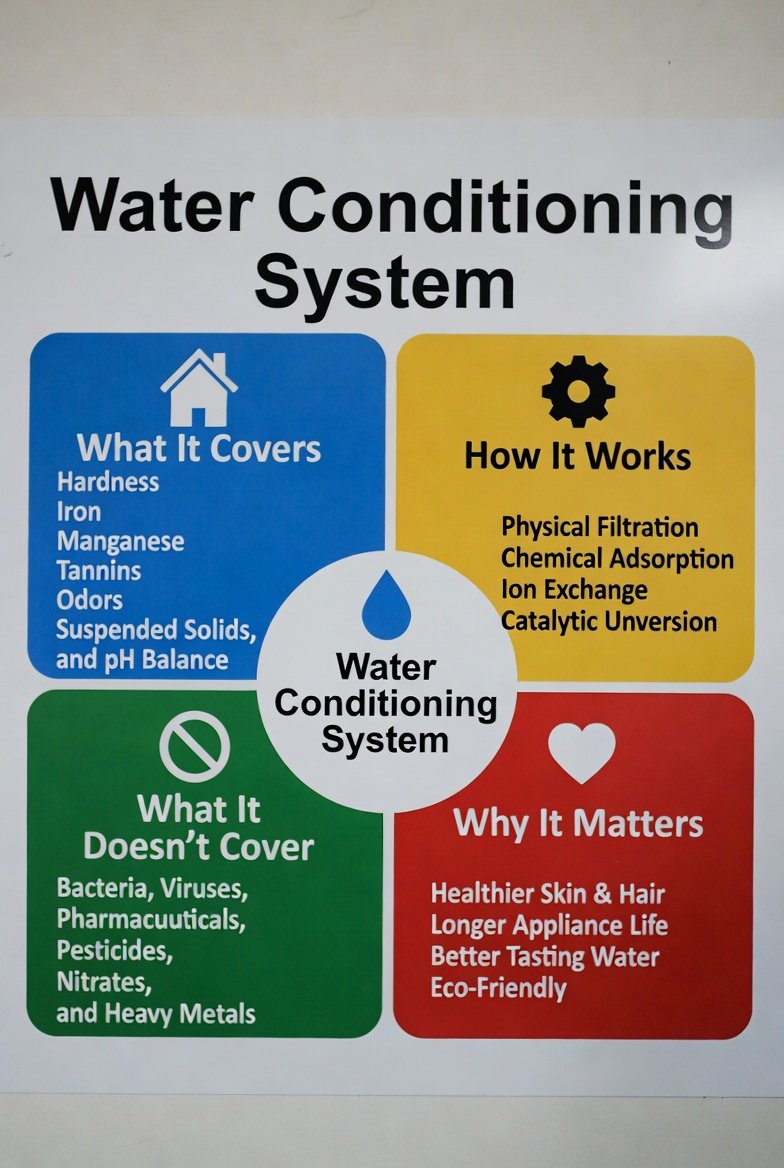
Water “conditioning” can mean different things.
It may involve:
- Hardness removal
- Scale reduction
- Dissolved contaminant reduction
- Taste improvement
There are two main system categories:
- Salt-Free Conditioners (TAC systems)
- Ion-Exchange Water Softeners
They do not perform the same job.
For structural chemistry differences, see:
👉water-softener-vs-reverse-osmosis
Top System Types by Scenario (Clear Ranking)
🥇 Best for Mild Hardness (0–10 GPG)
Salt-Free Conditioner (TAC)
Ideal when:
- Hardness is low to moderate
- Iron is minimal
- You want low maintenance
- You live in a salt-discharge restricted area
Pros:
- No salt refills
- No regeneration
- Minimal wastewater
Limitations:
- Does not reduce hardness reading
- Does not create “soft water feel”
🥇 Best for 10–20 GPG Hardness
32k–48k Grain Ion-Exchange Softener
Ideal when:
- You see scale buildup
- Soap doesn’t lather well
- Tankless heater present
- Appliance protection is priority
This range handles most 2–4 bathroom homes.
🥇 Best for 20+ GPG or High-Demand Homes
48k+ Grain High-Flow Softener
Ideal when:
- Very hard municipal water
- Large household
- Multiple simultaneous showers
- Tankless heaters or high-flow fixtures
At this level, salt-free systems often underperform.
🥇 Best for Full Protection (Hardness + Drinking Purity)
Softener + Reverse Osmosis Pairing
Softener protects plumbing.
RO improves drinking water purity.
Chemistry differences explained here:
👉water-softener-vs-reverse-osmosis
Hardness Threshold Selection Table
Hardness (GPG) | Recommended System |
0–7 | Salt-free conditioner may suffice |
7–12 | Either system depending on goals |
12–20 | Softener preferred |
20+ | High-capacity softener strongly recommended |
Above ~15 GPG, scale buildup accelerates.
Waiting too long leads to appliance damage.
What Problem Are You Solving? (Decision Matrix)
Water Issue | Best System | Why |
Hardness | Softener | Removes Ca/Mg |
Mild scale | Salt-free | Low maintenance |
Fluoride | RO | Membrane reduction |
Nitrates | RO | Effective removal |
Iron (well) | Iron filter first | Prevents fouling |
Taste issues | RO | Carbon + membrane |
Understanding the problem determines the system.
Sizing Logic (Grain Capacity Math Simplified)
Softener sizing depends on daily hardness load.
Basic formula:
Hardness (GPG) × gallons per day × number of people = grain demand
Example:
- 12 GPG hardness
- 75 gallons/day per person
- 4 people
12 × 75 × 4 = 3,600 grains/day
Multiply by 7 days → 25,200 grains weekly demand
A 32k or 40k grain system is appropriate.
Undersizing leads to:
- Frequent regeneration
- Reduced efficiency
- Performance drop
Sizing matters more than brand.
Flow Rate Sizing (GPM Matters)
Typical peak demand:
- 1–2 bathrooms → 7–10 GPM
- 3–4 bathrooms → 10–15 GPM
- 5+ bathrooms → 15+ GPM
If flow exceeds system rating:
- Pressure drops
- Scale control weakens
- Performance declines
Salt-free systems also have flow limitations.
Always match system flow to home demand.
Iron & Well Water Reality
If iron exceeds ~0.3 ppm:
- Salt-free media may foul
- Softener resin may clog
Typical well-water treatment train:
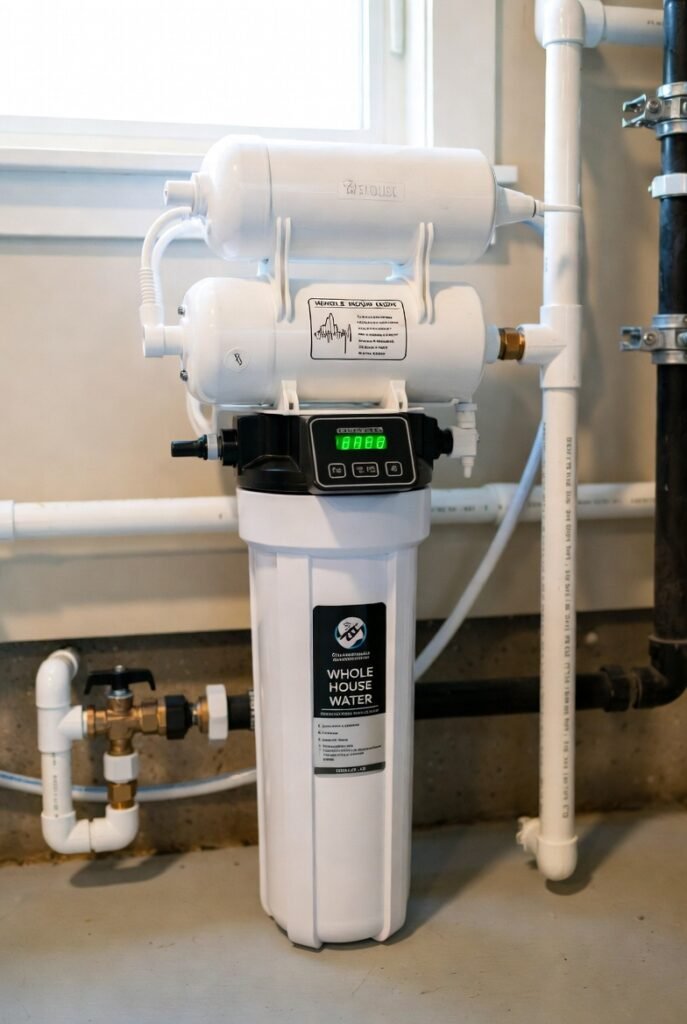
Well Pump → Pressure Tank → Sediment Filter → Iron Filter → Softener → Carbon → RO/UV
Skipping iron treatment is one of the most common buying mistakes.
Cost Range Expectations
Installed cost varies by region.
Typical ranges:
- Salt-free conditioner: ~$1,000–$3,000
- Softener: ~$1,200–$3,500+
- Softener + RO: Higher tier investment
Cost should follow water chemistry, not marketing claims.
Ownership expectations detailed here:
👉water-softener-system-cost
3 Common Buying Mistakes
- Choosing salt-free for 18+ GPG water
- Ignoring iron levels
- Undersizing system capacity
All three lead to dissatisfaction.
Real-World Scenario Examples
Tankless Heater Home (16 GPG):
Salt-free installed → continued scaling → frequent flushing required.
Well Water with Iron (0.8 ppm):
Conditioner installed first → media fouling → reduced effectiveness.
Undersized Softener in 5-Person Home:
Frequent regeneration → salt waste → reduced efficiency.
Testing prevents these issues.
Point of No Return (Damage Progression)
Hardness damage escalates:
Early:
- Spotting
Mid:
- Heater efficiency loss
Advanced:
- Tankless scaling
- Appliance repair
Installing the right system early reduces long-term costs.
Final Recommendation Hierarchy
If hardness >15 GPG → Softener wins.
If hardness <10 GPG & low iron → Salt-free may work.
If drinking water purity matters → Add RO.
There is no universal best.
There is only best for your chemistry.
FAQs
Is a salt-free conditioner better than a softener?
Only in mild hardness conditions and when low maintenance is priority.
Can a conditioner replace a softener?
In mild hardness zones below roughly 10–12 GPG.
How do I test my water hardness?
Use a test kit or municipal water report.
Do I need RO with a conditioning system?
Only if dissolved contaminants or taste issues are present.
What size softener do I need?
Calculate grain demand based on hardness, household size, and water usage.
What happens if I undersize my system?
Frequent regeneration, reduced efficiency, and potential performance loss.