
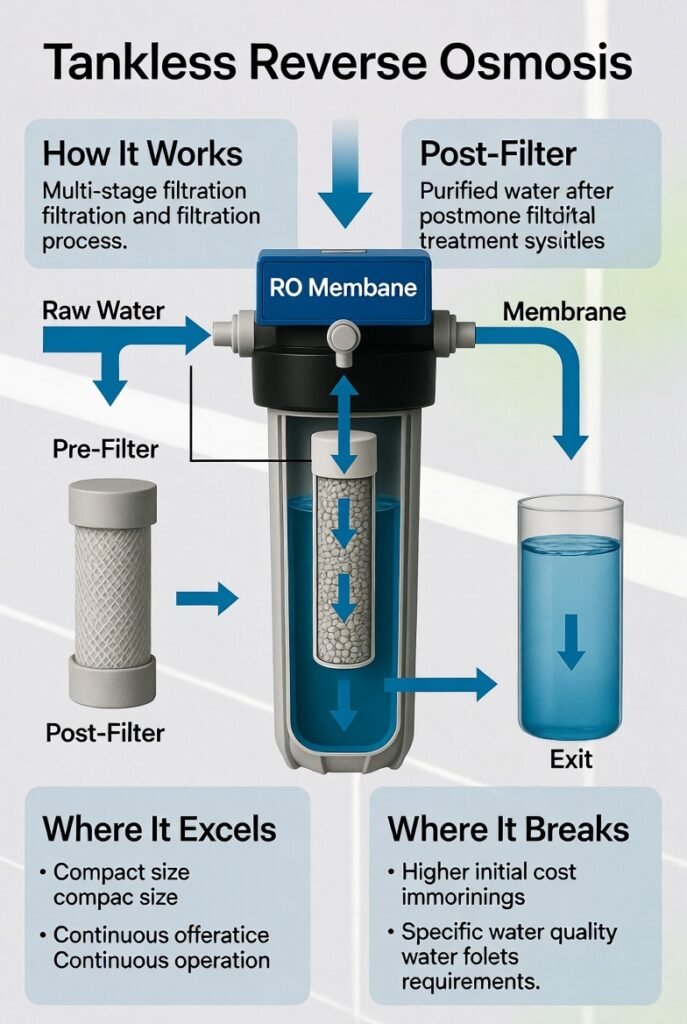
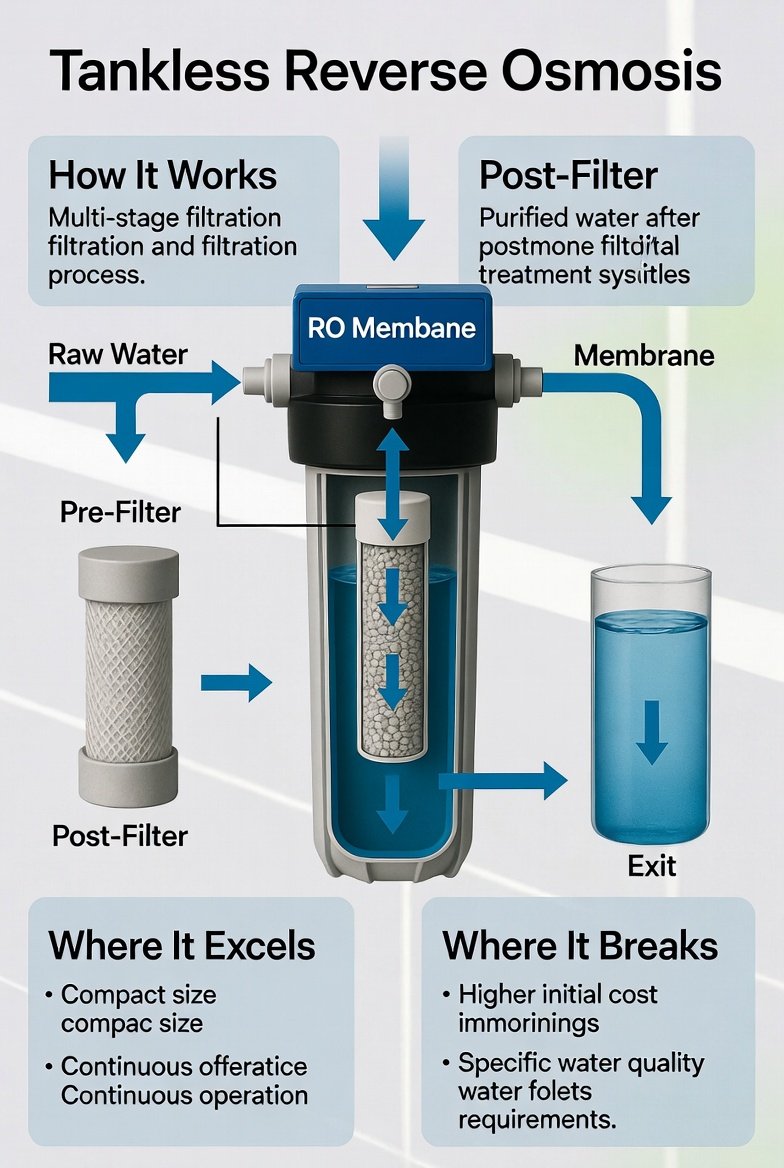
Tankless Reverse Osmosis System: Structure, Performance Limits, and Real-World Fit
A tankless reverse osmosis system looks like the obvious evolution of home water filtration.
No bulky tank.
More cabinet space.
“Instant” purified water.
The appeal is real.
But incomplete.
Tankless RO is not simply reverse osmosis without a tank — it is a structural trade-off. You remove the storage buffer and replace it with higher pressure dependence, tighter operating tolerances, and more mechanical stress per gallon.
When the home fits those requirements, tankless RO can feel precise, modern, even effortless.
When it doesn’t, the complaints arrive quickly:
- “The flow feels weak.”
- “It used to be faster.”
- “Why is it louder now?”
- “Did something break?”
Usually, nothing broke.
The system is revealing a mismatch that a tank would have hidden.
This guide explains how tankless RO actually works, what it demands from a home, where it excels, where it fails — and most importantly — how to decide without guessing.
Quick Structural Reality Check
Before choosing tankless, understand what you are committing to:
- Real-time filtration with no reserve supply
- Dependence on stable incoming pressure
- Faster membrane workload
- Less tolerance for installation errors
- Maintenance discipline that cannot drift
Verify: Many performance complaints associated with tankless RO trace back to pressure instability or delayed filter replacement rather than equipment defects.
Tankless systems are not fragile.
They are strict.
What Makes a Tankless RO System Fundamentally Different
Traditional under-sink RO systems purify water gradually and store it in a pressurized tank. When you open the faucet, you are mostly drawing from that stored supply while the system quietly refills it.
Tankless RO eliminates that buffer entirely.
Instead, water is purified on demand — often called direct-flow filtration.
That single design change creates four major consequences:
- No stored reserve
- Higher real-time production demand
- Stronger reliance on pressure stability
- Immediate visibility of performance issues
The easiest way to frame it:
Tank systems trade speed for forgiveness.
Tankless systems trade forgiveness for precision.
Neither is universally better.
Fit determines success.
What This Decision Really Commits You To
Tankless RO is often purchased for aesthetics.
It should be chosen for compatibility.
Because once installed, the system quietly expects your home to cooperate.
That means accepting:
- Ongoing pressure stability
- Timely filter replacement
- Proper installation geometry
- Reliable electrical supply (for powered units)
Unlike tank systems, tankless rarely masks underlying plumbing weaknesses.
It exposes them.
Structural Anatomy of a Tankless RO System
Despite the compact footprint, tankless systems are internally sophisticated.
Most include:
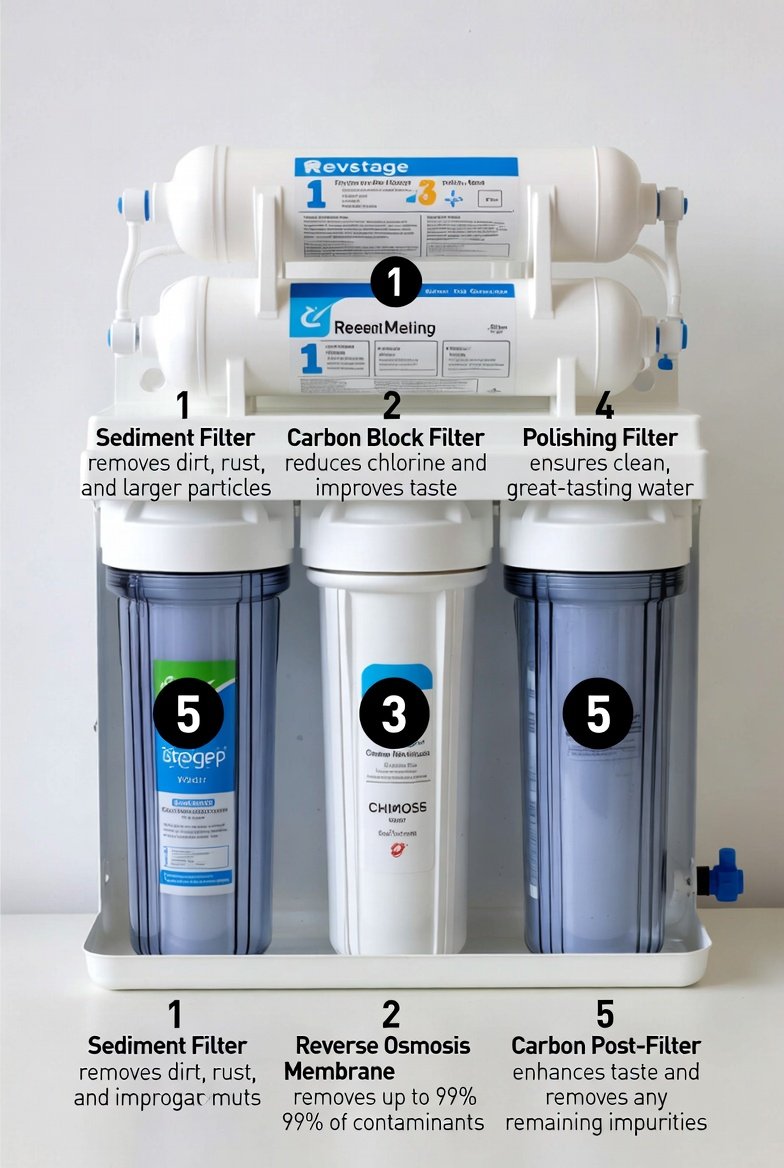
High-Efficiency RO Membranes
Designed for faster throughput to support on-demand use.
Multi-Stage Pre-Filtration
Sediment and carbon stages protect the membrane from premature fouling.
Integrated Booster Pump
Common in direct-flow models to stabilize production.
Electronic Sensors / Control Board
Manage flushing cycles, monitor filter life, and maintain performance.
Flow Restrictor + Auto-Flush Logic
Prevents the membrane from clogging under continuous workload.
What it typically does not include:
- A storage tank
- A slow refill safety buffer
- Performance forgiveness during pressure dips
Compact does not mean simpler.
It often means more condition-dependent.
Pressure Is the Non-Negotiable Requirement
If there is one deciding factor for tankless RO, it is this:
Stable pressure is not helpful — it is mandatory.
Many systems perform strongest around the mid-range of residential pressure, often roughly 40–60 psi, though exact requirements vary by model.
When pressure drops:
- Flow falls immediately
- The stream may pulse
- Production slows
- Noise often increases
- Owners assume the unit failed
Even with a booster pump, plumbing instability still matters. Pumps assist — they do not rewrite the physics of restricted lines, partially closed valves, clogged filters, or aging plumbing.
Installer insight: Tankless RO is frequently blamed for problems that originate upstream in the home’s pressure environment.
Performance Reality — When Tankless Feels Fast (And When It Doesn’t)
Tankless Feels Excellent When:
- Only one draw point is active
- Pressure is stable
- Filters are clean
- Tubing runs are short
- Drain routing is unobstructed
Tankless Feels Frustrating When:
- Multiple demands stack together
- Pressure dips
- Filters clog
- Drain lines create backpressure
Remember:
There is no buffer.
Performance is immediate — and so are problems.
Tankless RO Decision Matrix
Household Condition | Tankless Fit |
Strong, stable pressure | ✅ Excellent |
Moderate daily use | ✅ Strong |
Tight cabinet space | ✅ Ideal |
Large burst demand | ⚠️ Risky |
Pressure fluctuations | ❌ Poor |
Older plumbing | ❌ Often mismatch |
Choosing tankless without evaluating these variables is where regret usually begins.
Where Tankless Reverse Osmosis Excels
1. Space Efficiency
No tank means cleaner cabinet geometry and easier storage.
2. Continuous Fresh Production
Some homeowners prefer eliminating stored water psychologically — even though tank water is already sealed and safe.
3. Competitive Water Efficiency
Many modern designs aim for improved reject-to-pure ratios compared with older tank systems.
Efficiency still depends heavily on reverse osmosis installation and maintenance.
4. Strong Match for Predictable Use
Homes drawing water steadily — rather than in heavy bursts — often experience smooth performance.
Where Tankless RO Breaks Down
This is where many guides soften reality.
Failure modes are predictable.
Low or Unstable Pressure
Tankless punishes weak plumbing.
“Instant Water” Expectations
It is fast — not infinite.
Membranes still govern output.
Filter Discipline Becomes Non-Negotiable
Clogged filters immediately reduce flow and strain components.
Proprietary Cartridge Economics
Some systems use manufacturer-specific filters:
- Easier replacement
- Less price flexibility
- Potentially higher lifetime cost
- Reverse osmosis system cost
Convenience and economics often move together.
Installation Sensitivity
Small mistakes surface quickly:
- Poor drain geometry
- Kinked tubing
- Incorrect flow direction
- Inconsistent power
Tankless systems are strict — not fragile.
Why Many Installers Quietly Evaluate the Home First
Experienced installers rarely treat tankless as plug-and-play.
They often assess:
- Pressure stability
- Plumbing age
- Line restrictions
- Expected usage
Not to complicate the sale — but to prevent callbacks.
Field observation: Dissatisfaction usually stems from condition mismatch, not filtration performance.
The “Point of No Return” — Damage Progression
Tankless problems often follow a pattern:
- Slight slowdown
- Noticeable flow drop
- Taste complaints
- Reactive part replacements
- Membrane stress
- Rising ownership cost
The real turning point is repeatedly fixing symptoms instead of stabilizing pressure and replacing filters.
After that, frustration compounds.
Tankless vs Traditional Tank RO
Aspect | Tank System | Tankless |
Storage buffer | Yes | No |
Cabinet footprint | Larger | Compact |
Pressure tolerance | Higher | Lower |
Forgiveness | High | Low |
Best for | Burst demand | Stable environments |
Tank systems cushion inconsistency.
Tankless rewards stability.
Tankless vs Whole-House RO — Know the Boundary
Tankless is still point-of-use.
It purifies drinking and cooking water.
It does not:
- Treat showers
- Prevent scale
- Protect appliances
- Replace softening
- Whole-house reverse system
Infrastructure problems require infrastructure solutions.
Tankless is precision — not scale.
Maintenance Trade-Off: Fewer Legacy Parts, Higher Discipline
Tankless systems may eliminate tanks and some fittings, but they typically demand tighter upkeep.
Ownership usually hinges on:
- Timely pre-filter replacement
- Pressure awareness
- Normal flushing behavior
- Acceptance of cartridge economics
If your maintenance style is “I’ll get to it later,” tank systems are often more forgiving.
If your maintenance style is consistent, tankless performs beautifully.
The Long-Term Ownership Gravity
Ask a harder question before choosing:
Will my home still support this system five to ten years from now?
Pressure conditions change.
Plumbing ages.
Usage evolves.
Tankless is not just a design choice.
It is a compatibility decision.
Simple Fit Test Before You Choose
Tankless Is Usually a Strong Fit When:
- Pressure is stable
- Space is limited
- Usage is predictable
- Maintenance cost will stay consistent
Tankless Is Usually a Poor Fit When:
- Pressure fluctuates
- Large bursts are common
- Plumbing is restrictive
- Upkeep tends to slip
Choosing tankless purely for aesthetics is the wrong reason.
Structural requirements always win.
Final Structural Perspective
A tankless reverse osmosis system is not universally better than a tank system.
It is stricter.
When a home meets its pressure and usage requirements, tankless RO delivers fast, clean water in a compact footprint — often with impressive efficiency.
When the home does not meet those requirements, performance issues surface quickly.
So the real question is not:
“Is tankless premium?”
It is:
“Does my home actually fit it?”
Precision always outperforms aspiration.