
5-Stage Reverse Osmosis System Explained: How It Works, What It Covers, and Where It Stops
Most homeowners assume a tankless reverse osmosis system is “good” simply because five sounds complete.
That assumption is exactly where confusion begins.
Stage count has quietly replaced system logic in many buying decisions. People choose filtration based on numbers instead of structure — then blame the system when it fails to solve problems it was never designed to address.
A 5-stage RO system is not powerful because it has more filters.
It is powerful because each stage protects a single precision component: the reverse osmosis system membrane.
This guide resets that logic so you understand what five stages actually accomplish, where their authority ends, and how to decide with structural clarity instead of marketing pressure.
Quick Structural Reality Check
Before going deeper, anchor this:
- A 5-stage system is designed for drinking-water precision, not whole-home treatment
- It depends heavily on upstream protection
- It rewards maintenance discipline
- It performs best under predictable municipal conditions
Verify: Many RO performance complaints stem from misapplication — not poor filtration capability.
Five stages are not a promise of universality.
They are a design boundary.
What “5-Stage” Actually Means — And What It Doesn’t
A 5-stage RO system does not use five separate purification technologies.
Instead, it uses five coordinated steps arranged in a protective sequence.
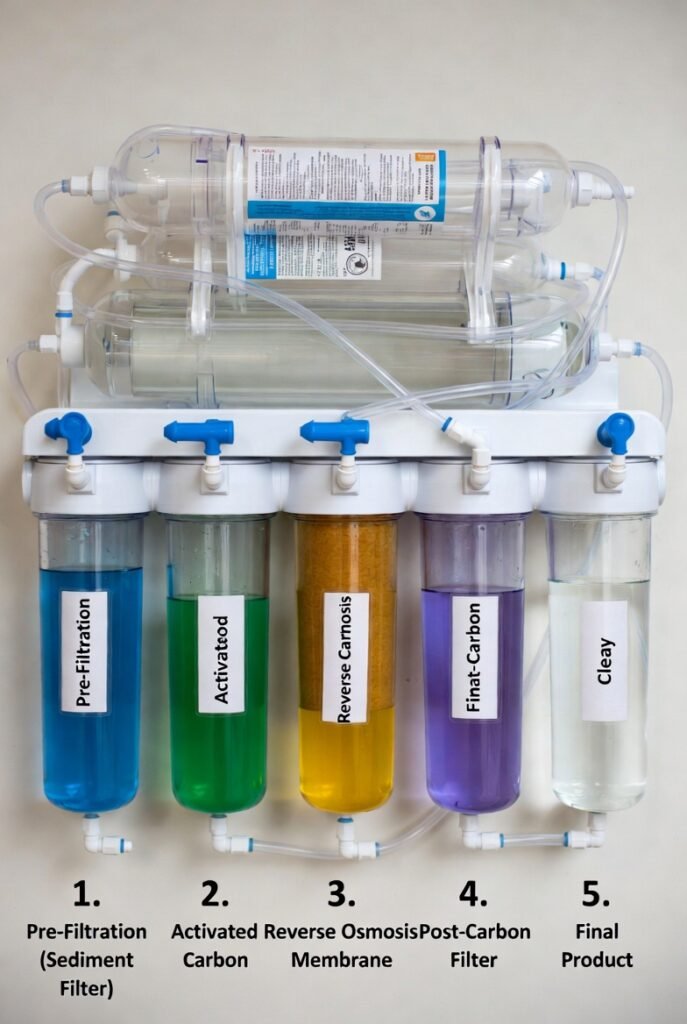
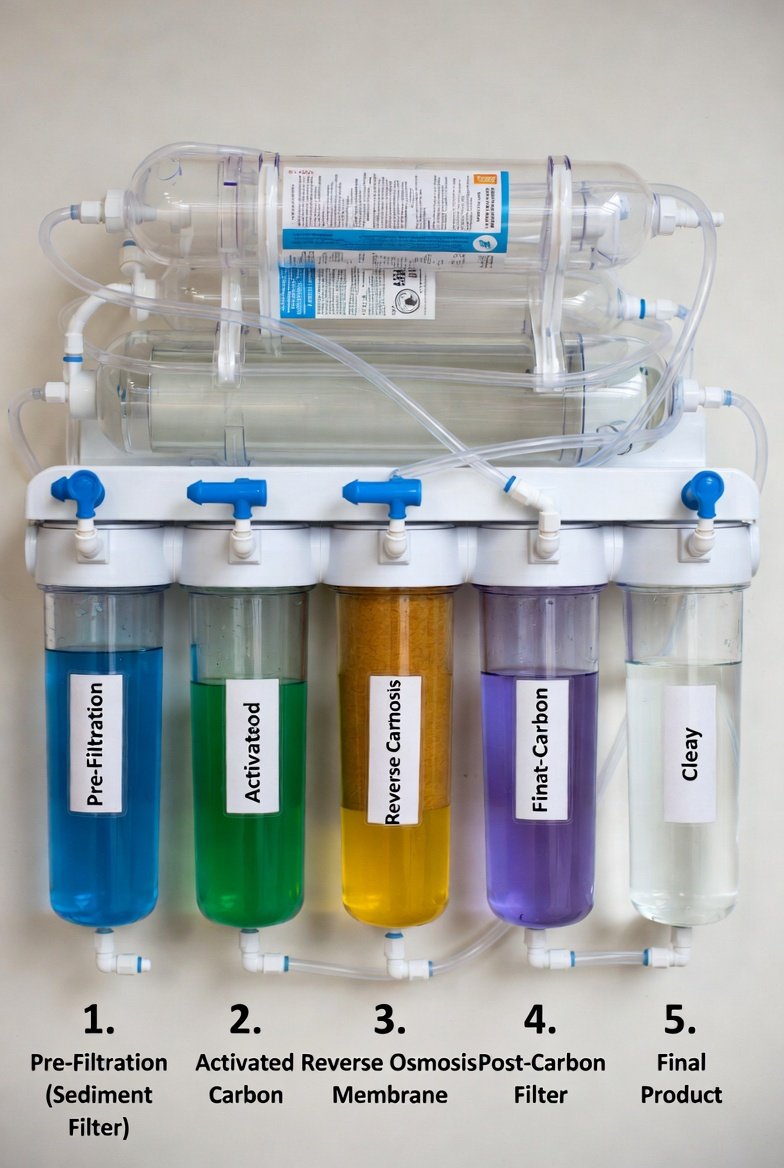
In most residential systems, the architecture looks like this:
- Three pretreatment stages
- One RO membrane
- One polishing stage
- RO Installation
This structure is about process control, not excess filtration.
Every early stage exists to protect the membrane — because the membrane is both the most valuable and most vulnerable component in the system.
Break that protection chain, and performance falls regardless of how many extra stages you add later.
Why Five Stages Became the Residential Standard
Five stages represent a balance between protection, performance, cost, and physical footprint.
Fewer stages often expose the membrane.
More stages often modify output rather than improve purification.
Think of the system as a controlled workflow:
Early stages absorb damage.
The membrane performs separation.
The final stage restores usability.
It is a deliberate architecture — not a marketing number.
Structural Anatomy of a 5-Stage RO System
Stage Position | Functional Role | Strategic Purpose |
Stage 1–3 | Pretreatment | Protect the membrane |
Stage 4 | Reverse osmosis | Perform molecular separation |
Stage 5 | Post-filtration | Improve drinkability |
Remove any layer, and downstream stress rises.
Stage-by-Stage Breakdown (With Operational Purpose)
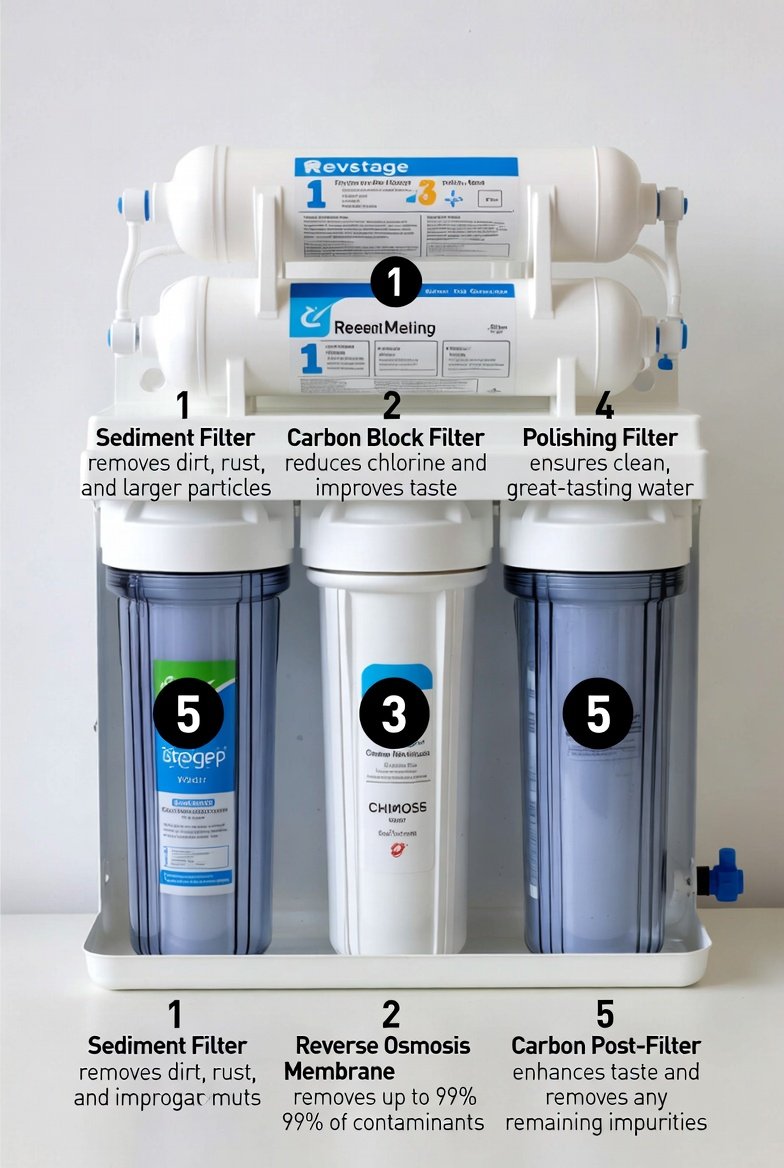
Stage 1 — Sediment Filter (Mechanical Defense)
Role: Physical protection
Removes: Sand, rust, silt, visible debris
This stage absorbs mechanical abuse so downstream filters do not clog prematurely.
It does not improve taste.
It preserves system flow.
When ignored, every subsequent stage degrades faster.
Stage 2 — Carbon Pre-Filter (Chemical Shield)
Role: Chemical protection
Targets: Chlorine, organic compounds
Chlorine damages RO membranes.
This stage exists primarily to keep chlorine away from the membrane — not to “upgrade” water quality directly.
On municipal supplies, it is effectively non-negotiable.
Stage 3 — Secondary Carbon Filter (Load Stabilizer)
Role: Redundancy and contact time
This stage rarely produces dramatic taste differences. Its value appears gradually by stabilizing filtration when water quality fluctuates.
It extends membrane life quietly — which is exactly what good pretreatment should do.
Stage 4 — Reverse Osmosis Membrane (True Separation)
Role: Molecular filtration
Removes:
- Dissolved solids
- Many heavy metals
- Nitrates
- Fluoride
- Numerous inorganic contaminants
This is the only stage performing true reverse osmosis.
Everything before it protects it.
Everything after it refines the experience.
When output declines, the cause is usually upstream — not the membrane itself.
Stage 5 — Post-Carbon Filter (Polishing)
Role: Taste refinement
Removes residual odors and improves mouthfeel.
This stage does not make water safer.
It makes the water enjoyable enough that people continue using the system.
Systems without polishing often test well — yet get abandoned due to flat taste.
Adoption matters.
Stage Impact Snapshot
Stage | Primary Job | What It Protects | What Fails If Skipped |
1 | Sediment removal | Entire system | Clogging, pressure loss |
2 | Chlorine removal | Membrane | Chemical damage |
3 | Load stabilization | Membrane lifespan | Premature wear |
4 | RO separation | Final purity | Contaminant breakthrough |
5 | Taste polishing | User adoption | System abandonment |
Protection — not quantity — is what makes five stages effective.
What a 5-Stage System Does NOT Do
Understanding limits is where expertise begins.
A standard 5-stage RO system does not:
- Soften hard water
- Fix low pressure
- Treat the entire home
- Eliminate maintenance cost
- Handle heavy iron or sulfur alone
When these boundaries are ignored, homeowners add stages instead of fixing the real upstream problem.
More filters cannot compensate for structural mismatch.
Why Some 5-Stage Systems Fail Early
Early failures rarely indicate flawed design.
They usually reflect process neglect.
Common causes include:
- Skipped filter replacements
- Chlorine reaching the membrane
- Low feed pressure
- Excessive hardness upstream
Adding stages after the membrane does not correct any of these.
Protection always matters more than expansion.
5-Stage vs 6- or 7-Stage Systems — Reality Check
Additional stages often introduce:
- Remineralization
- Alkalization
- Specialty media
These modify water characteristics.
They do not strengthen contaminant removal.
Useful when:
- Taste preference matters
- pH adjustment is desired
But they are refinements — not structural upgrades.
Marketing often blurs this distinction.
Engineering does not.
When a 5-Stage System Is Exactly Enough
Five stages are sufficient when:
- The goal is drinking and cooking water
- Source water is municipal or lightly contaminated
- Space efficiency matters
- Maintenance stays consistent
This describes the majority of residential use cases.
For many homes, a well-maintained 5-stage system represents the optimal balance of simplicity and performance.
When Five Stages Are Not Enough
Additional treatment is typically required when:
- Water hardness is extreme
- Sediment load is unusually high
- Iron or sulfur is present
- Whole-home conditioning is necessary
In these scenarios, the correct fix is upstream pretreatment — not stacking more filters under the sink.
Infrastructure problems demand infrastructure solutions.
The Most Common 5-Stage Buying Mistake
The biggest misunderstanding is this:
“Five stages means the system handles everything.”
It does not.
A 5-stage RO system is a precision drinking-water instrument.
Used correctly, it performs exceptionally.
Misapplied, it disappoints — regardless of stage count.
Maintenance Reality by Stage
Ownership RO cost follows a predictable hierarchy:
- Sediment & carbon filters → replaced most often
- RO membrane → lasts longer but costs more
- Post-filter → inexpensive yet important for usability
Neglecting early stages raises total lifetime cost by shortening membrane lifespan.
Protection is always cheaper than replacement.
The Long-Term Ownership Perspective
Ask a smarter question before choosing:
Does my water problem belong inside an RO system — or upstream of it?
When the system matches the problem:
Ownership feels uneventful.
Costs remain predictable.
Performance stays stable.
When it doesn’t:
Filters clog faster.
Membranes strain earlier.
Frustration rises.
Precision beats excess every time.
Final Structural Clarity
A 5-stage reverse osmosis system works because each stage has a defined role — and stays within it.
Its authority is deliberately limited.
For most homes, that limitation is exactly what makes it reliable.
The real decision is not whether five stages are “good.”
It is whether the problem you are solving belongs inside the RO system at all.
Structure always outperforms marketing.