
Best Water Softener System: How to Choose Without Overbuying
Most homeowners don’t buy the wrong water softener because they’re careless.
They buy the wrong one because the category is engineered to confuse.
Marketing pushes oversized systems.
Sales language blurs conditioners with true softeners.
Capacity numbers sound like safety.
And suddenly a simple hardness problem turns into a multi-thousand-dollar guessing game.
This page is your decision owner.
No hype.
No brand bias.
No “premium by default.”
Just the structural logic behind choosing the right water softener — so you solve scale problems once instead of managing them forever.
The First Truth: There Is No Universal “Best”
The best water softener system is not the largest.
Not the most expensive.
Not the one with the most features.
It is the system that quietly does its job for the next 10–15 years without forcing you to think about it.
A properly chosen softener should feel almost invisible.
If you are constantly adjusting it, refilling it too often, or questioning performance — the sizing or selection was likely wrong from the start.
Quick Reality Check — Do You Actually Need One?
Before comparing systems, confirm that hardness is the real problem.
Strong indicators include:
- White scale on faucets or showerheads
- Soap that refuses to lather
- Cloudy glassware
- Stiff laundry
- Water heater efficiency dropping
- Appliances aging faster than expected
- Measured hardness above ~7 grains per gallon (gpg)
If your main concern is taste, odor, or contaminants, a softener alone will not solve it.
Softening changes water behavior — not drinking quality.
The $2,000–$4,000 Mistake Homeowners Make
The most common buying error is surprisingly simple:
👉 People size for fear instead of reality.
They double capacity “just in case.”
They buy feature-heavy units they’ll never use.
They assume bigger equals safer.
What actually happens?
Oversized systems regenerate inefficiently, waste salt, and allow resin beds to sit too long — which can reduce performance over time.
The goal is not maximum capacity.
The goal is regeneration efficiency.
Correct sizing beats impressive specs every time.
Reverse Osmosis vs Water Softener — Don’t Mix the Roles
This confusion drives massive overbuying.
Problem | Water Softener | Reverse Osmosis |
Scale & hardness | ✅ Yes | ❌ No |
Appliance protection | ✅ Yes | ❌ No |
Drinking water purity | ❌ No | ✅ Yes |
Whole-home treatment | ✅ Yes | ❌ No |
A softener protects your house.
Reverse osmosis protects what you drink.
Many homes benefit from both — but never for the same reason.
The Three Real Types of Water Softener Systems
Forget brand names. Nearly every residential system fits into one of these structures.
Understanding the structure matters far more than memorizing logos.
1. Salt-Based Ion Exchange Softeners (The Benchmark)
If hardness is truly damaging your home, this is still the gold standard.
How it works:
Resin beads exchange calcium and magnesium for sodium or potassium ions, preventing scale formation.
Why it remains the default choice:
- Proven performance across decades
- Predictable hardness removal
- Strong appliance protection
- Works reliably even in very hard water
Trade-offs:
- Requires salt refills
- Uses water during regeneration
- Adds a small amount of sodium
For most hard-water homes, this is not just “a good option.”
It is the reference point everything else gets measured against.
2. Salt-Free Conditioners (Often Misunderstood)
Despite the marketing, these are not true softeners.
What they do:
Attempt to alter mineral behavior so scale is less adhesive.
What they do NOT do:
Remove calcium or magnesium.
When they may make sense:
- Mild hardness
- Low visible scale
- Areas with salt restrictions
- Owners prioritizing minimal maintenance
Where buyers go wrong:
Installing one after scale is already severe — and expecting reversal.
Conditioners are preventive tools, not corrective ones.
3. Dual-Tank & High-Efficiency Systems
These are specialized versions of salt-based systems — not automatic upgrades.
Best suited for:
- Large households
- High simultaneous water use
- Homes where soft-water interruption is unacceptable
Because one tank regenerates while the other stays active, you never experience hardness breakthrough.
But for an average household, they often solve a problem that doesn’t exist.
More equipment is not inherently smarter.
Typical Installed Cost (Reality Anchors)
Prices vary regionally, but realistic ranges prevent emotional decision-making.
System | Typical Installed Range |
Single-tank salt system | $1,000 – $2,500 |
Dual-tank system | $2,500 – $4,500 |
Salt-free conditioner | $1,500 – $3,000 |
Higher price usually reflects:
- Valve sophistication
- Installation complexity
- Tank configuration
—not “better softening.”
Never confuse cost with capability.
Capacity: Where Overbuying Quietly Happens
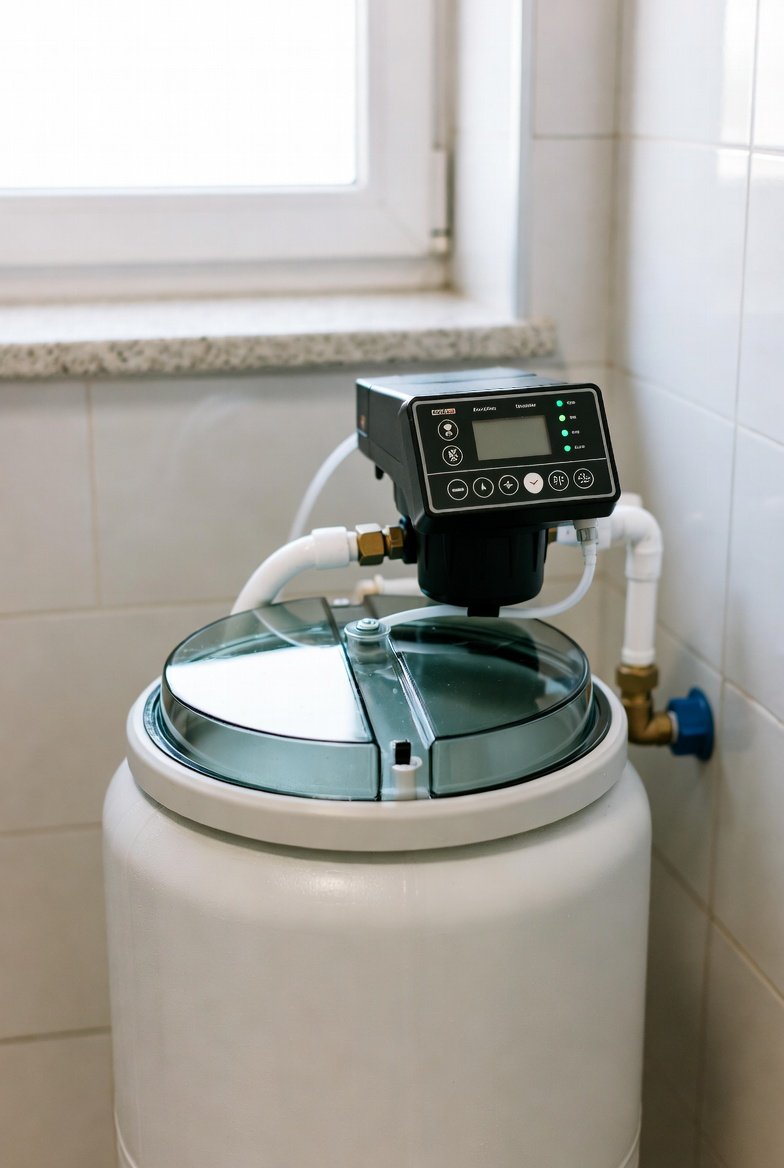
Softener capacity is measured in grains (32K, 48K, etc.).
But the real formula is simpler:
👉 Hardness × daily water usage = required capacity
Real-World Example
Family of four
15 gpg hardness
~300 gallons per day
Oversizing dramatically may cause inefficient regeneration cycles — wasting salt and reducing system effectiveness.
The best system regenerates regularly and efficiently, not rarely and dramatically.
Consistency protects resin.
Single-Tank vs Dual-Tank — A Usage Decision
Single-Tank
- Lower upfront cost
- Regenerates overnight
- Brief hardness window
Best for most homes.
Dual-Tank
- Continuous soft water
- No regeneration downtime
- Higher purchase cost
Best for high-demand households.
This is not about prestige — it is about usage patterns.
Control Valves Matter More Than the Brand
Most homeowners focus on tank size.
Professionals focus on the valve.
The valve determines:
- When regeneration occurs
- How much salt is used
- Water efficiency
- Whole water filtration
- Long-term reliability
Look for:
✅ Demand-initiated regeneration
✅ Adjustable programming
✅ Widely supported components
Cheap valves are responsible for a surprising number of “bad softener” stories.
Maintenance Reality (No Sugarcoating)
Every true softener requires some involvement.
Expect:
- Salt refills every few weeks to months
- Occasional brine tank cleaning
- Resin lifespan around 10–15 years when sized correctly
There is no zero-maintenance system that performs the same job at the same reliability level.
If zero maintenance is your priority, expectations — not equipment — need recalibration.
Efficiency vs Performance — The Hidden Trade-Off
Ultra-efficient systems reduce salt and water use.
Performance-focused systems prioritize hardness removal.
The smartest choice balances both based on your water chemistry.
Too efficient → struggles in very hard water.
Too aggressive → wastes resources in mild conditions.
Matching always beats maximizing.
When the Best System Is Actually Two Systems
Many homes benefit from role separation.
Common high-logic pairings:
👉 Water softener + under-sink reverse osmosis
Softener protects infrastructure.
RO purifies drinking water.
👉 Softener + whole-house carbon filter
Hardness controlled.
Chlorine taste reduced.
This is not upselling.
It is structural clarity.
At-a-Glance Comparison
System Type | Removes Hardness | Whole-Home | Maintenance | Best For |
Salt-Based | ✅ Yes | ✅ Yes | Moderate | Most hard-water homes |
Salt-Free | ❌ No | ✅ Yes | Low | Mild hardness |
Dual-Tank | ✅ Yes | ✅ Yes | Moderate | High-usage homes |
How to Avoid Overbuying (The Calm System Test)
The best water softener system is almost boring:
- Correctly sized
- Predictable
- Efficient
- Easy to live with
- Water conditioner
No surprise costs.
No performance drama.
If a system sounds exciting, it is probably solving the wrong problem.
Water treatment should feel uneventful.
That’s success.
Final Decision Framework
Choose a system that:
✔ Matches measured hardness
✔ Fits real household usage
✔ Regenerates efficiently
✔ Aligns with your maintenance tolerance
✔ Solves scale without introducing friction
The “best” system is rarely the one dominating advertisements.
It’s the one you stop thinking about after installation.
Clarity — not complexity — prevents regret.